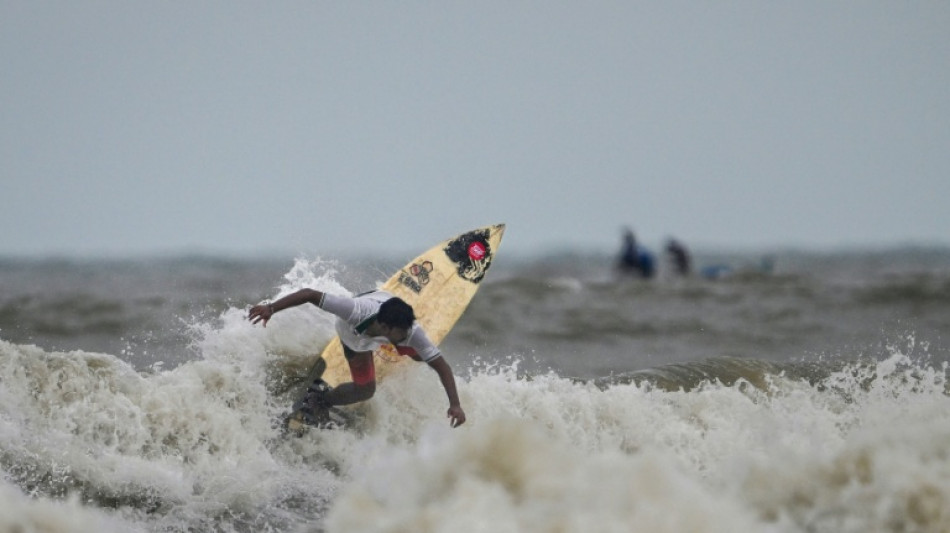
Pipe dreams: Bangladesh surfers chase waves at Asian Games / Photo: Munir UZ ZAMAN - AFP
The headquarters of the Bangladesh Surf Girls and Boys Club is a weather-beaten white shack but, like the seemingly endless beach on which it sits, its members' ambitions stretch far.
For Mohammad Mannan, 25, and Fatima Akhter, 16, their thoughts are fixed on the upcoming surfing competition at the Asian Games, to be held in Japan from September 19 to October 4.
The surfers from Cox's Bazar -- one of the world's longest beaches that stretches for 120 kilometres (75 miles) along the Bay of Bengal -- are hoping to carve out a place for the sport in a country obsessed with cricket and football.
"The moment I step onto the board, I forget everything else," said Akhter, who has had to overcome intense stigma in the Muslim-majority nation to succeed as a teenage girl riding her board.
"When I successfully ride a wave, I feel happy and fulfilled," she said.
"The feeling is impossible to describe."
Mannan's journey to the Asian Games -- where surfing makes its debut this year -- began on the same shores, selling seashell jewellery to support his family. He began skateboarding as a boy, but then turned to the waves.
"Skateboarding was a much smaller sport than surfing," he said. "I was mesmerised by surfing, because it was connected to water."
His parents urged him to give up surfing and concentrate on his studies, convinced there was no future in the sport. Mannan refused.
"I believed surfing would eventually grow," he said. "Surfing isn't a lucrative sport in Bangladesh now, but nobody can say it never will be."
- 'In love with surfing' -
Mannan has competed internationally in India and the Maldives, but opportunities are scarce.
He studies the world's best from afar, watching YouTube videos of Hawaii-born two-time world champion John John Florence to refine his technique.
"Surfers from other countries are different, because they have better boards, bigger waves, and travel frequently to different countries," Mannan told AFP.
"It's impossible to understand an ocean if you've never surfed there."
His first trip to the Maldives was a shock. Used to Bangladesh's five-foot (1.5 metre) waves, he found himself facing 15-foot breaks.
Club founder Rashed Alam has no illusions about the scale of the challenge.
"You can't improve without proper training, and we don't have any sponsors to send our surfers abroad," he said.
But for Alam, one of the pioneers of the sport in Bangladesh, that struggle is nothing new. Surfing's unlikely history in the country has always been one of chance, generosity and improvisation.
He traces its arrival to Cox's Bazar in 2004, when four American tourists came to ride the waves.
"Four big guys from Hawaii, with their board shorts and big cameras, came to ride our waves," he said.
Other foreign surfers followed, leaving behind boards for local enthusiasts, including Alam.
"That's how I fell in love with surfing," he said.
The passion eventually took him to California, where he worked as a surf instructor and lifeguard, before returning to Bangladesh in 2013 and opening the country's first surfing club.
"I thought, if men can surf, girls can surf too," he said. "It was exceptionally challenging to teach girls in Bangladesh because of community and family pressure."
Alam coaches young surfers -- many of them street children -- in their shared ambition to ride the waves.
"We have no local equipment," he said. "Everything we use comes from donations."
- 'Hold on to surfing' -
Mannan hopes his Asian Games debut will prove that surfing has a future in Bangladesh.
"I want to build a career in surfing," he said.
For Akhter, reaching the Games in Japan as a young woman has been especially tough. Her father died when she was young and her mother, who works as a cook, has urged her to marry.
Cox's Bazar is among the poorest regions in Bangladesh, where child labour and child marriage remain widespread.
"The biggest problem is poverty. Girls... are expected to contribute to their families' income," she said.
"The friends who taught me to surf were victims of child marriage," Akhter said. "They still miss their days at the beach and always tell me: 'Don't get married. Hold on to surfing'."
But the waves offer hope.
The youngest club member, 10-year-old Mehedi Hasan, survives alone on the streets.
"I am on my own; I sing for tourists and often give them massages," Hasan told AFP.
But he has his own small board, and he feels free when he rides the waves.
"I am small, and sometimes the waves go over my head," he said. "But it feels fantastic when I overcome them."
D.Nielsen--RTC