
Sidney Resources Corporation Identifies District-Scale Structural and Hydrothermal System at Warren Project; Survey Confirms Strategic Claim Position Within Core Target Corridor
Integrated geophysical data confirms a continuous mineralized corridor and strengthens the project's relevance to domestic critical mineral supply.
WARREN, ID / ACCESS Newswire / March 24, 2026 / Sidney Resources Corporation (OTCID:SDRC) ("Sidney" or the "Company") is pleased to announce the completion and initial interpretation of its recently conducted airborne magnetic and radiometric survey across the Warren District in Idaho.

The high-resolution helicopter-borne magnetic and radiometric survey across the Warren District has now been successfully completed, conducted at approximately 30-meter terrain clearance with 50-meter line spacing for comprehensive district-wide coverage. The resulting detailed geophysical dataset provides robust support for structural and lithologic interpretations, confirming SDRC's claims as centrally located within a prospective structural and hydrothermal corridor west/southwest of the historic town of Warren.
The integrated dataset has identified a district-scale structural and hydrothermal system, while also confirming that SDRC's claims are strategically positioned within a central, highly prospective portion of the system near and west/southwest of the historic town of Warren.
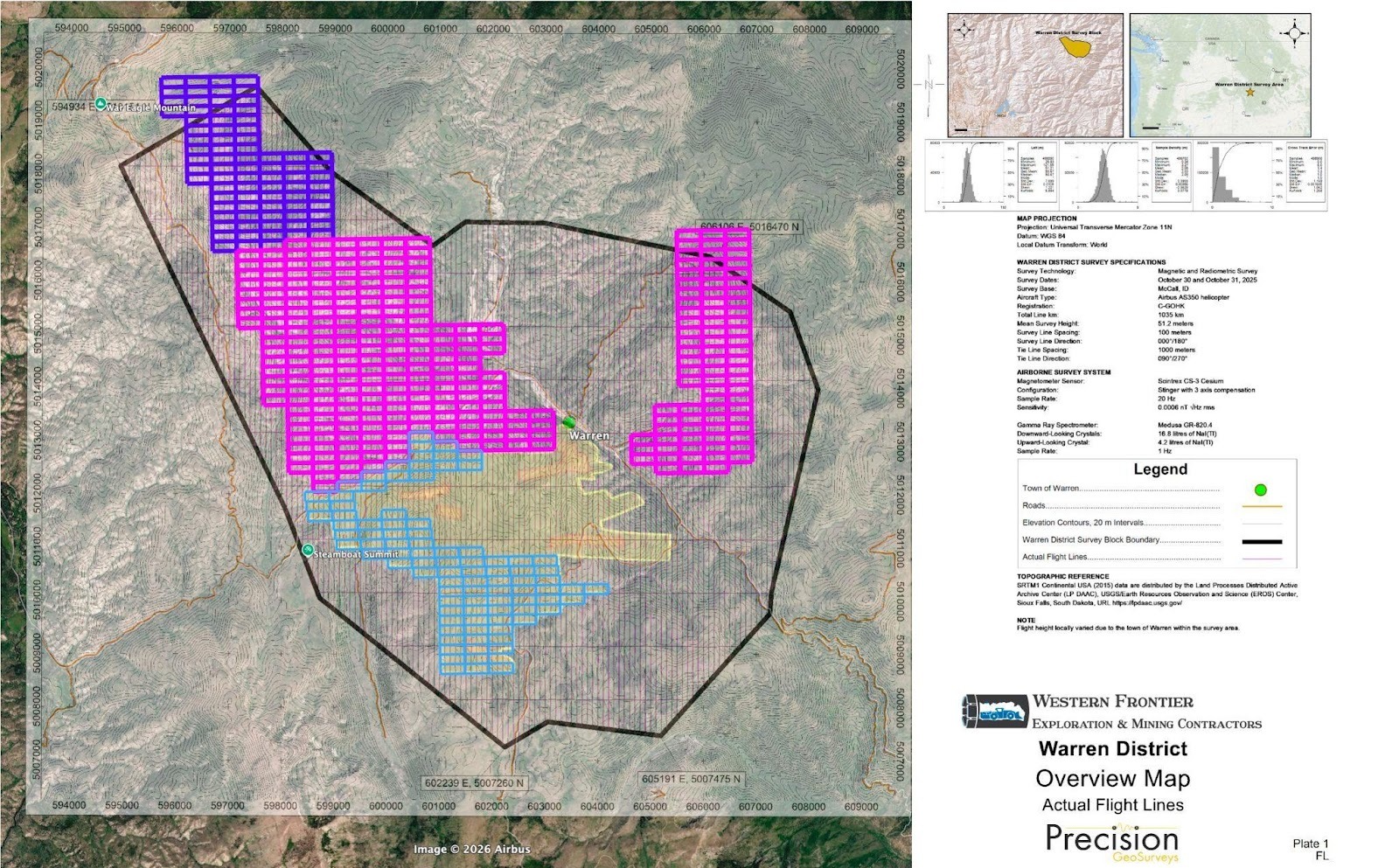
Figure 1 - Airborne Survey Coverage and SDRC Claim Position within the Warren District, highlighting proximity to the historic town of Warren and core target corridor.
Survey Confirms Strategic Claim Position Within Core System
The airborne survey confirms that SDRC's claim package is not peripheral to the broader district, but instead occupies a central transition zone within the interpreted mineral system.
The Company's claims are situated:
Across a broad structural and geophysical transition corridor
Within a zone exhibiting overlapping magnetic and radiometric signatures
Along a trend extending west and southwest from Warren toward Steamboat Summit
This positioning is considered highly favorable, as mineral systems are commonly focused along structural boundaries, intrusive margins, and zones of hydrothermal alteration-all of which are indicated within or immediately adjacent to SDRC's ground.
Magnetic Survey Defines Structural Architecture and Intrusive Framework
The magnetic survey outlines a large-scale geophysical framework across the Warren District, including:
Distinct magnetic domains representing contrasting rock packages
Multiple structural corridors trending NW-SE and NE-SW
Evidence of cross-cutting fault systems and structural intersections
Broad magnetic signatures consistent with intrusive influence
Importantly, SDRC's claims appear to lie across a central magnetic transition zone near Warren, where contrasting magnetic responses converge.
Such transition zones are commonly associated with:
Structural breaks and offsets
Intrusive contacts and margins
Enhanced permeability for mineralizing fluids
This interpretation suggests that SDRC controls ground prospective for structurally focused mineralization rather than isolated or discontinuous targets.
"This is an incredibly successful magnetic survey. It has significantly advanced our understanding of the structural framework controlling mineralization in the Warren District," said Steve Dobson, Project Geologist. "The data has revealed a well-developed network of structural corridors and intersections characteristic of productive mineral systems. With follow-up induced polarization surveys planned for this summer, we expect to further refine these targets and continue evaluating the broader district-scale mineral system potential."
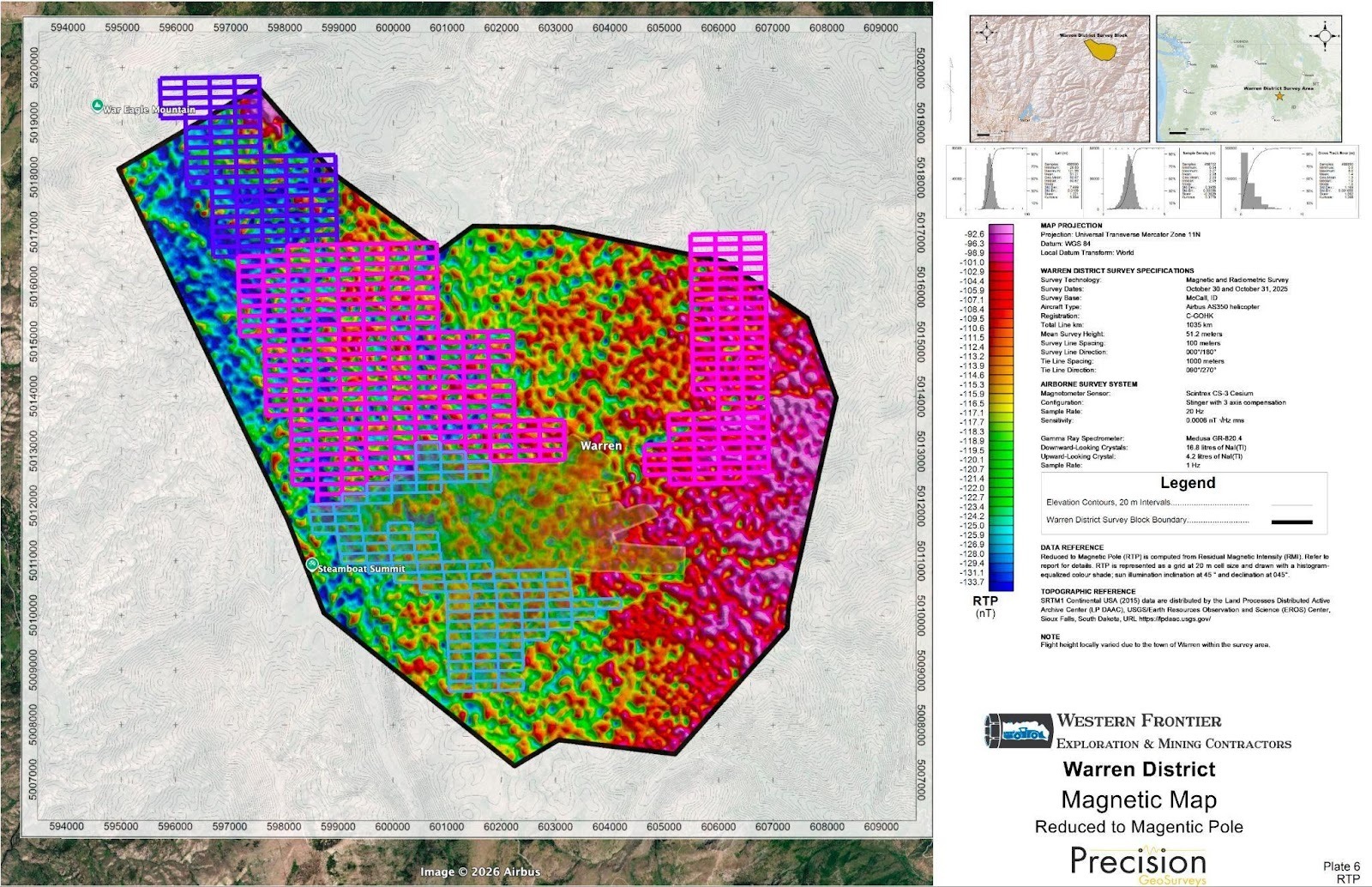
Figure 2 - Reduced-to-Pole Magnetic Map highlighting structural corridors and magnetic domain boundaries. SDRC claims are positioned across a central magnetic transition zone near Warren.
Radiometric Survey Confirms Widespread Hydrothermal Alteration and Fluid Activity
The radiometric survey provides strong evidence for hydrothermal alteration and fluid-related processes across the district, identifying:
Elevated potassium (K) responses across central and northern zones
Strong potassium-to-thorium (K/Th) anomalies indicative of alteration
Localized uranium enrichment associated with fluid pathways
Distinct geochemical zoning across the survey area
Notably, SDRC's claims overlap portions of the central and west-central radiometric response, where variability and elevated signatures suggest active or historic hydrothermal systems.
Potassium enrichment relative to thorium is widely recognized as an indicator of sericite alteration, commonly associated with mineralized environments.
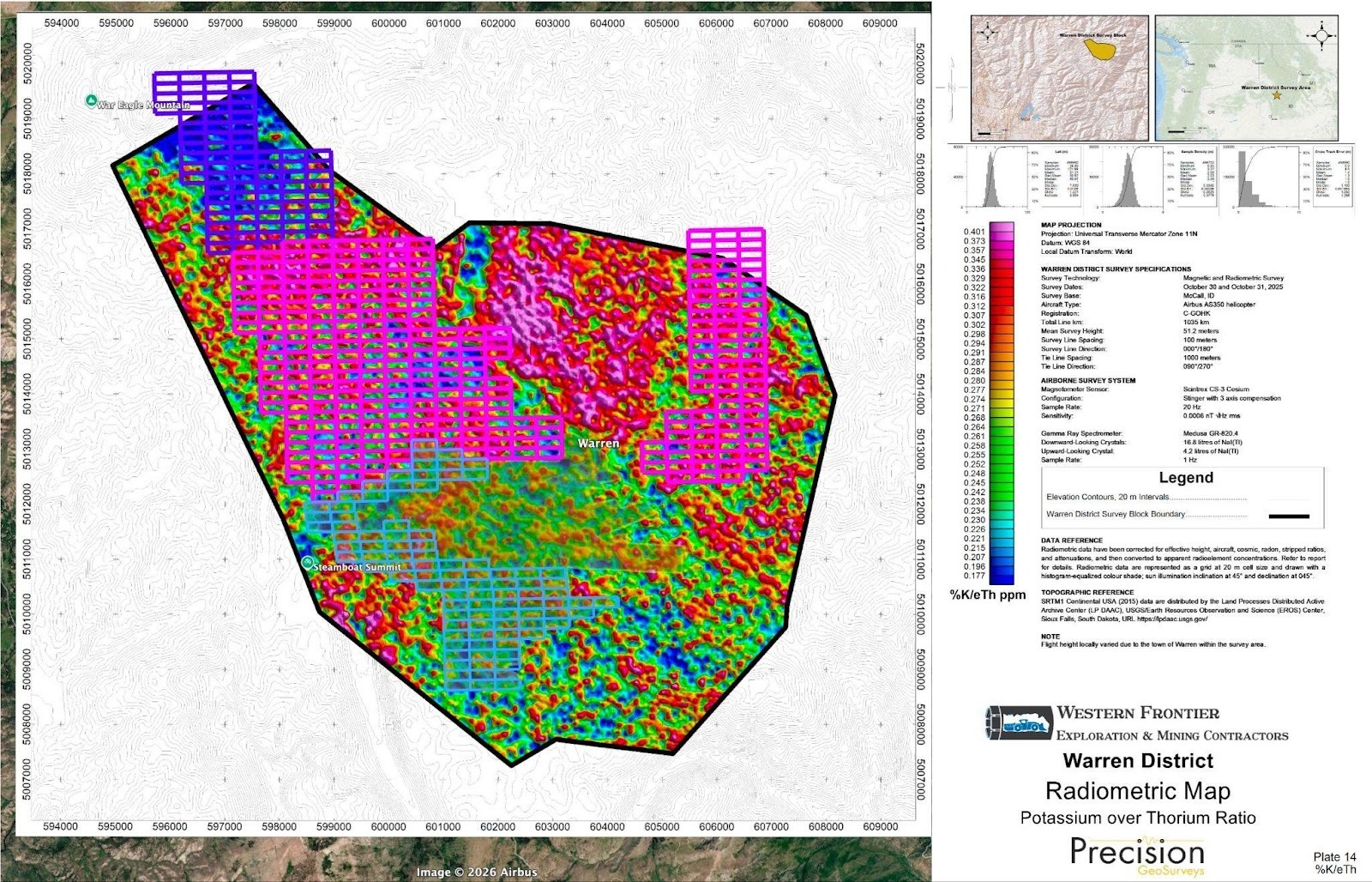
Figure 3 - Potassium-to-Thorium (K/Th) Ratio Map highlighting zones of hydrothermal alteration. SDRC claims overlap portions of the district's central alteration footprint.
Integrated Interpretation Identifies Multiple High-Priority Target Zones
The true significance of the survey lies in the convergence of independent datasets.
When magnetic and radiometric results are integrated, SDRC has identified zones where:
Major structural features intersect
Magnetic boundaries and disruptions occur
Hydrothermal alteration (high K/Th) is present
Radiometric signatures suggest fluid movement
Importantly, several of these overlapping signatures occur on or immediately adjacent to SDRC's claim package, particularly in areas surrounding and extending west/southwest of Warren.
These coincident signatures represent priority exploration targets, as they indicate areas where structure, alteration, and fluid pathways intersect-key components of mineral system development. The broader implications of these integrated results provide important context for understanding the scale of the system at Warren:
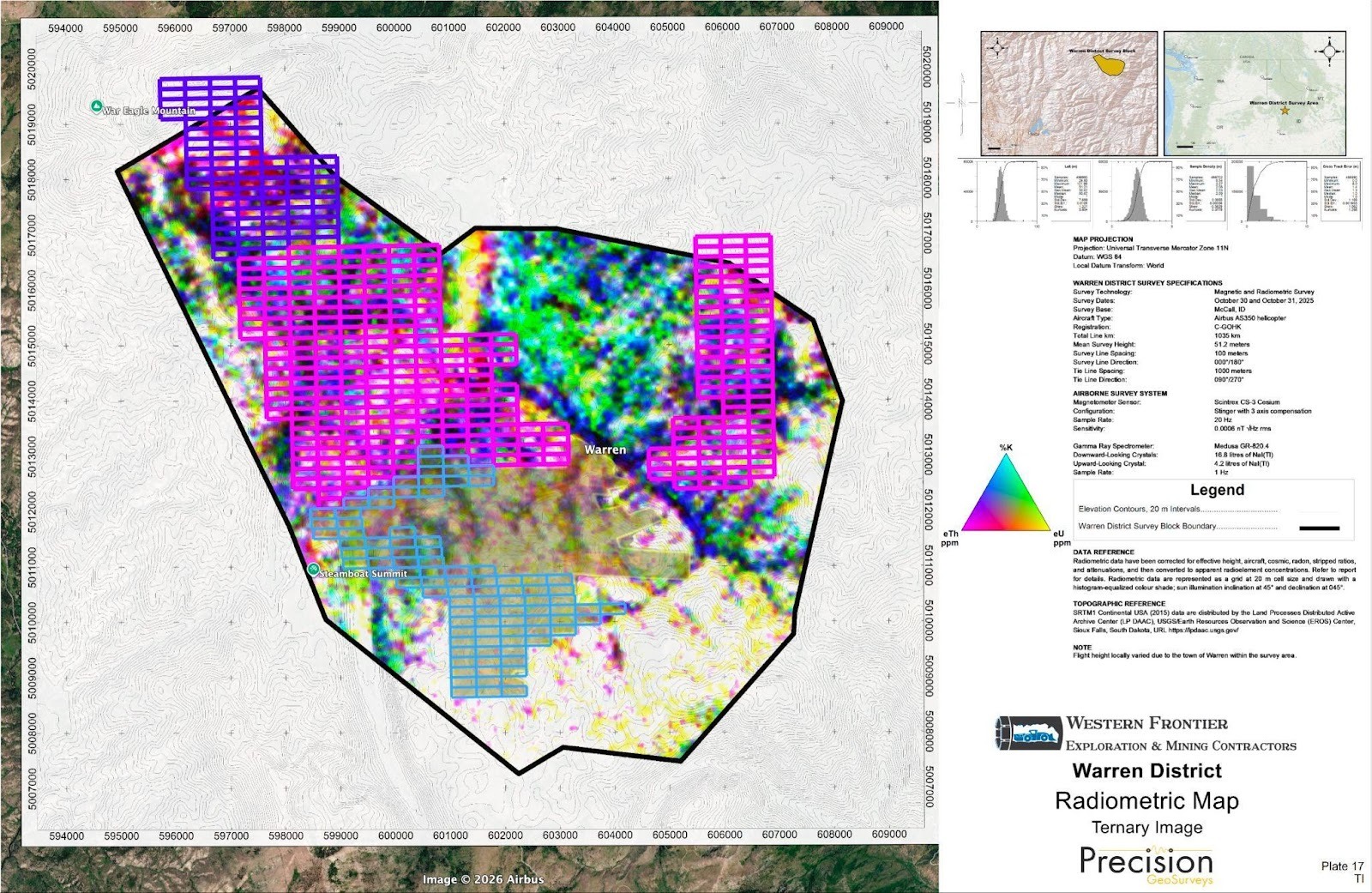
Figure 4 - Ternary Radiometric Image (K-Th-U) illustrating integrated lithologic, alteration, and fluid signatures. SDRC claims occupy a complex, mixed-response corridor within the broader system.
Geological Context and System Scale
The scale and continuity of the geophysical responses at Warren are consistent with large, structurally organized hydrothermal systems observed in established mineral districts.
In particular, the data indicate:
Kilometer-scale structural organization
Broad, laterally continuous alteration signatures
Evidence of multiple phases of fluid activity
These characteristics are commonly associated with mineral systems where historic mining has only exploited a portion of a much larger geological footprint.
Importantly, these comparisons are made strictly at the system scale-not at the deposit or resource level. The current geophysical results do not define grade, tonnage, or economic potential, but do indicate that the Warren District hosts a robust and well-developed mineral system capable of supporting multiple target zones.
District-Scale System Confirmed
The integrated results support a critical advancement in the Company's understanding of the Warren Project:
The property hosts a continuous, district-scale mineral system characterized by structural complexity, intrusive influence, and widespread hydrothermal alteration.
SDRC's claims are positioned within a central convergent zone of this system, rather than outside of it, significantly enhancing the exploration potential of the Company's ground.
Advancing Toward Drill-Ready Targets
The results of the airborne survey represent a major technical milestone for SDRC, clearly defining the key components of a district-scale mineral system directly across the Company's claim position.
Magnetic data has outlined a robust structural framework, while radiometric responses confirm widespread hydrothermal alteration and fluid activity. The convergence of these datasets has allowed SDRC to identify multiple high-priority target zones where structure, alteration, and fluid pathways coincide-critical ingredients for mineralization.
Importantly, these signatures are not isolated elsewhere in the district, but occur on or immediately adjacent to SDRC's claims, confirming the Company's strategic position within the core system corridor near and west/southwest of Warren.
With this foundation now established, SDRC is advancing rapidly toward execution, including:
Refinement of structural interpretation and target ranking
Ground truthing and surface sampling across priority zones
Integration with historical workings and known mineral occurrences
Evaluation of follow-up geophysical methods, including induced polarization (IP)
Advancement toward drill targeting and exploration planning
These steps are designed to transition the project from geophysical interpretation to drill-ready targets, positioning SDRC for the next phase of value creation.
CEO Commentary:
"These results represent a major step forward in our understanding of the Warren District and reinforce our long-held belief that this is a large, structurally controlled mineral system," said Sean Rae Zalewski, CEO of Sidney Resources Corporation.
"What is particularly encouraging is that our claim position sits within a central corridor near and west of Warren where structure, alteration, and fluid signatures converge. That combination is exactly what we look for when defining high-quality exploration targets."
"At a system level, we are seeing structural and alteration characteristics that are consistent with those observed in well-known mineral districts, including portions of the Tintina Gold Province and the Cripple Creek District. These comparisons are qualitative and speak to the scale and organization of the system, not to grade or economic potential."
"We've now moved beyond concept and into clearly defined, data-driven targets. With follow-up work already planned, including induced polarization surveys and field validation, our focus is on advancing these zones toward drill-ready status and unlocking the broader potential of the district."
About Sidney Resources Corporation
Sidney Resources Corporation (OTCID:SDRC) is a U.S.-based mineral exploration and development company primarily focused on high-grade gold exploration and underground development, with additional exposure to silver, tungsten, platinum group metals (PGMs), and select rare earth element (REE) opportunities within Idaho's historic Warren Mining District. The Company controls over 4,000 acres of patented and unpatented mineral rights and expanded its district-scale footprint through an additional 7,600 acres comprising 371 newly staked mining claims, targeting both historically productive gold-bearing systems and REE-prospective pegmatites. Recent metallurgical and processing work has demonstrated successful gravity concentration, smelting, and physical recovery of polymetallic material, including confirmed recovery of platinum group metals. Sidney Resources is advancing scalable, modular processing pathways while continuing to develop responsible mining and bioremediation technologies designed to support long-term, environmentally conscious operations and disciplined asset advancement.
Forward-Looking Statements
This press release contains forward-looking statements within the meaning of Section 27A of the Securities Act of 1933, as amended, and Section 21E of the Securities Exchange Act of 1934, as amended. Forward-looking statements include, but are not limited to, statements regarding future events, the Company's ability to raise capital, operational progress, development plans, and future financial performance. These statements are subject to known and unknown risks, uncertainties, and other factors that may cause actual results, levels of activity, performance, or achievements to differ materially from those expressed or implied by such forward-looking statements. Readers are cautioned not to place undue reliance on forward-looking statements, as they involve risks and uncertainties that are, in some cases, beyond the Company's control. Any forward-looking statements reflect the current views of Sidney Resources Corporation with respect to future events and are subject to assumptions and risks relating to, among other things, operations, results of operations, growth strategy, liquidity, regulatory approvals, permitting, market conditions, and financing. The Company undertakes no obligation to publicly update or revise any forward-looking statements, whether as a result of new information, future events, or otherwise, except as required by applicable law.
For a discussion of risk factors and uncertainties, please refer to the Company's public disclosures and filings with OTC Markets Group Inc., which are available through commercial document retrieval services and on the OTC Markets website. For additional information regarding Sidney Resources Corporation, including its environmental, social, and governance (ESG) initiatives, please visit the Company's website.
For Further Information, Please Contact
Dan Hally
Chief Operating Officer
Sidney Resources Corporation
Phone: 509-552-9858
Email: [email protected]
Website: https://sidneyresources.com/
SOURCE: Sidney Resources Corp.
View the original press release on ACCESS Newswire
T.Cortez--RTC