
Deposit Modeling at Thor Shows that the Proven Thor Epithermal Deposit is Flanked on Both Sides by a Much Larger Deposit
Thor's Upside Exposed!
ESTES PARK, CO / ACCESS Newswire / March 18, 2026 / Taranis Resources Inc. ("Taranis" or the "Company") (TSX.V:TRO)(OTCQB:TNREF) is providing an update on exploration planning at its Thor Project in the Silver Cup Mining District of British Columbia. Results from the Company's 2025 drilling program have led to a significantly refined geological interpretation of the Thor system, and have identified two high-priority exploration targets that will anchor the Company's 2026 exploration strategy. More information can be found at www.taranisresources.com
The 2025 drilling campaign, designed to test for deep intrusive-style mineralization beneath the Thor epithermal deposit, yielded several unexpected geological discoveries that have improved the understanding of the deposit geology. One of the most significant outcomes of the 2025 program was the identification of near-surface polymetallic mineralization east of the Thor deposit in what is now referred to as the Borr Zone. This discovery has proven that the 145 (+/-3) million year ("MYA") old (Jurassic/Cretaceous boundary) epithermal mineralization (recently dated by K/Ar methods) extends 1.3 km beyond the limits of the historically drilled Thor deposit and provides the first direct evidence that the Thor deposit is larger than previously known. This age of mineralization at Thor is identical to the famous Barkerville Mines in the Cariboo District.
The 2025 drilling program intersected an intrusive lamprophyre dyke previously unknown at Thor, which has now been modeled to scale. Although the dyke itself is not mineralized, its presence has proven critical in understanding the structural evolution of the deposit and the relationship between intrusive activity and epithermal mineralization. The lamprophyre dyke appears to have genetic origins from a much larger intrusive body, referred to as I-1, which remains untested. Pyritized xenoliths of the I-1 intrusive found in the lamprophyre dyke are porphyritic and alkalic.
"The Deeper the Geological Understanding, the Higher the Odds of Discovery"
The Thor Mineral Resource extends over approximately 2.8 km of strike length, but has comparatively limited vertical extent. New local and district-scale modeling indicates that this geometry is not a primary hydrothermal attribute - but reflects a preserved fragment of a once larger, and presently broken-up, intact epithermal system that has been structurally disrupted by the intrusive lamprophyre and related alteration, and faulting that accompanied the lamprophyre intrusion.
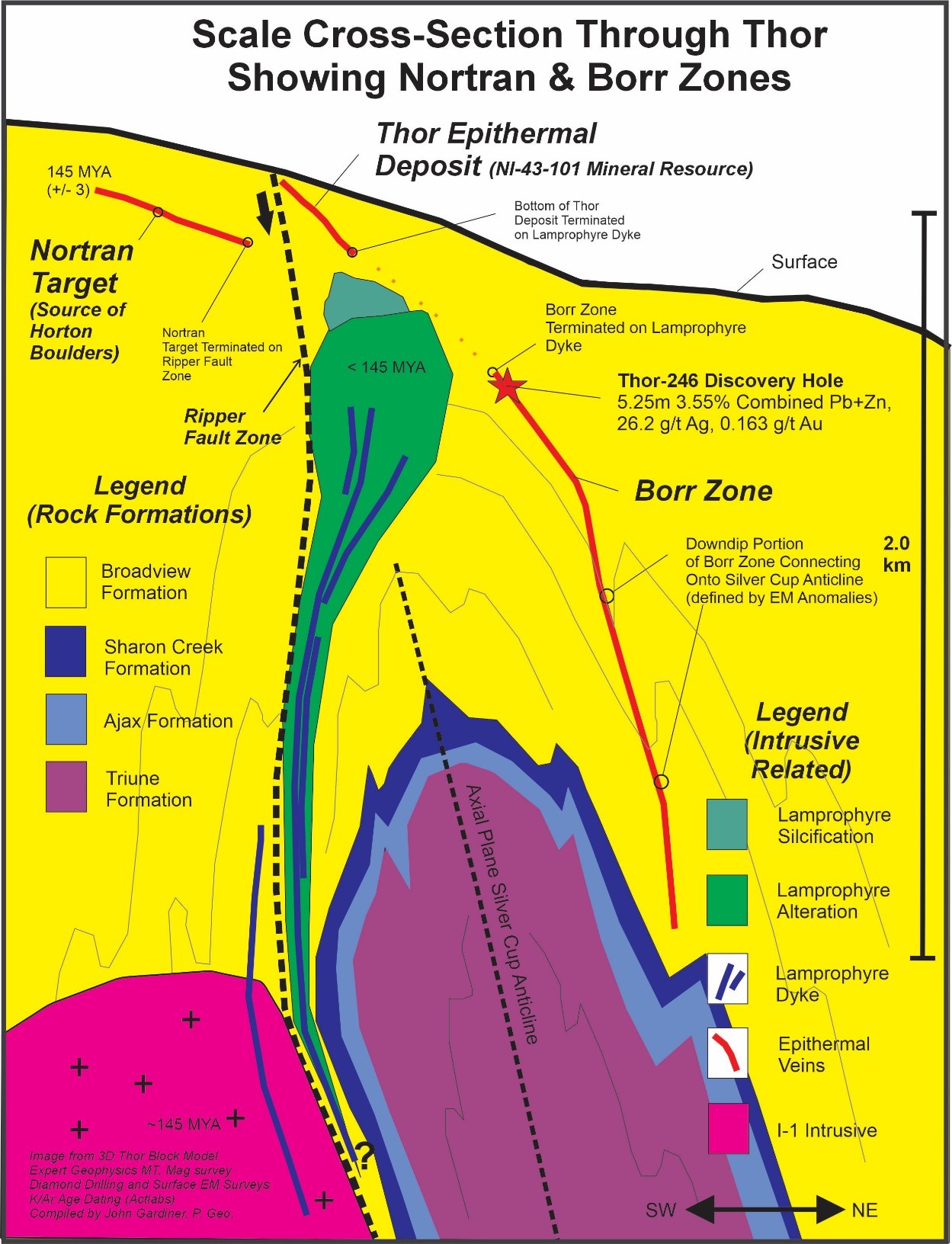
The Thor deposit represents a "rafted" block that was displaced upward during emplacement of the lamprophyre intrusive system subsequent to 145 MYA. The Thor deposit as it exists now, is cut-off on its west side by the Ripper Fault, and 'truncated' on its eastern side by the younger lamprophyre intrusive. This finding is important because it means that there are portions of the epithermal system that remain undiscovered southwest and northeast of the existing deposit. One of these - the Borr Zone - was already conclusively proven to exist in 2025.
The 3D model has highlighted two areas of particular interest for the addition of prospective high-grade epithermal mineralization: the Nortran Target to the southwest of Thor, and additional drilling to enlarge the Borr Zone to the east.
Nortran Target (Western Deeps)
At least one hundred high-grade mineralized float boulders were discovered west of the Thor deposit beginning in 2022. This boulder field occurs directly downhill from series of conductive EM anomalies, defining the Nortran Target area. Nortran is interpreted to be the faulted-off western edge of the Thor epithermal system. The modeling of the lamprophyre intrusive body and its affiliated alteration shell show that the western edge of the lamprophyre dyke and its related alteration served as the focal area for the development of the Ripper Fault. The Nortran area appears to be equivalent in surficial area to the existing Thor deposit.
Borr Zone
Drilling completed in 2025 intersected epithermal mineralization east of the lamprophyre dyke, confirming that epithermal mineralization continues on the opposite side of the intrusive lamprophyre body.
Like the main Thor deposit, Borr is a tabular zone that dips moderately (~45 degrees) northeast parallel to the mountain side and extends down to Ferguson Creek. Just below Ferguson Creek, the regional-scale Silver Cup Anticline plunges NW under the Thor property. Subsurface modeling of geology and EM shows that the roots of the Borr Zone extend into the apex and flanks of the Silver Cup Anticline. The prospective target at Borr is important because, if it is contiguous, it represents an area approximately five times the size of the existing Thor deposit.
Comments
John Gardiner, CEO of Taranis Resources Inc., commented "Our updated geological model indicates that the currently defined Thor deposit likely represents only one preserved fragment of a much larger epithermal system. Historically, exploration in the district focused primarily on the prominent vein structures that were mined more than a century ago.
The discoveries made during our 2025 drilling program, and the systematic integration of the geological data into a 3D model demonstrates that mineralization may also occur outside the historically important Thor deposit. The identification of both the Nortran and Borr targets marks an important step forward in understanding the full scale of the Thor system and provides two additional compelling exploration targets for our upcoming drill program."
Qualified Person
Exploration activities at the Thor Project were overseen by John Gardiner (P. Geo.), President and CEO of Taranis Resources Inc., and a Qualified Person under Canadian National Instrument 43-101. Mr. Gardiner is the principal of John J. Gardiner & Associates, LLC, operating in British Columbia under Firm Permit Number 1002256. Mr. Gardiner has reviewed and approved the technical information contained in this news release.
Quality Control and Laboratory Methods
K-Ar age dating was completed by Actlabs, Geometallurgy-MLA Department in Ancaster, Ontario. The sample consisted of a sericite concentrate from the Broadview Mine open pit. Argon was extracted from the sample at 1700oC, and argon content was carried out on an MI-1201 IG mass spectrometer.
Taranis currently has 102,421,487 shares issued and outstanding (119,972,613 shares on a fully diluted basis).
TARANIS RESOURCES INC.
Per: John J. Gardiner (P. Geo.), President and CEO
For further information contact:
John J. Gardiner
681 Conifer Lane
Estes Park, Colorado 80517
Cell: (720) 209-3049
[email protected]
NEITHER THE TSX VENTURE EXCHANGE NOR ITS REGULATION SERVICES PROVIDER (AS THAT TERM IS DEFINED IN THE POLICIES OF THE TSX VENTURE EXCHANGE) ACCEPTS RESPONSIBILITY FOR THE ADEQUACY OR ACCURACY OF THIS NEWS RELEASE.
This News Release may contain forward-looking statements based on assumptions and judgments of management regarding future events or results that may prove to be inaccurate as a result of factors beyond its control, and actual results may differ materially from expected results.
SOURCE: Taranis Resources Inc.
View the original press release on ACCESS Newswire
F.Peeters--RTC