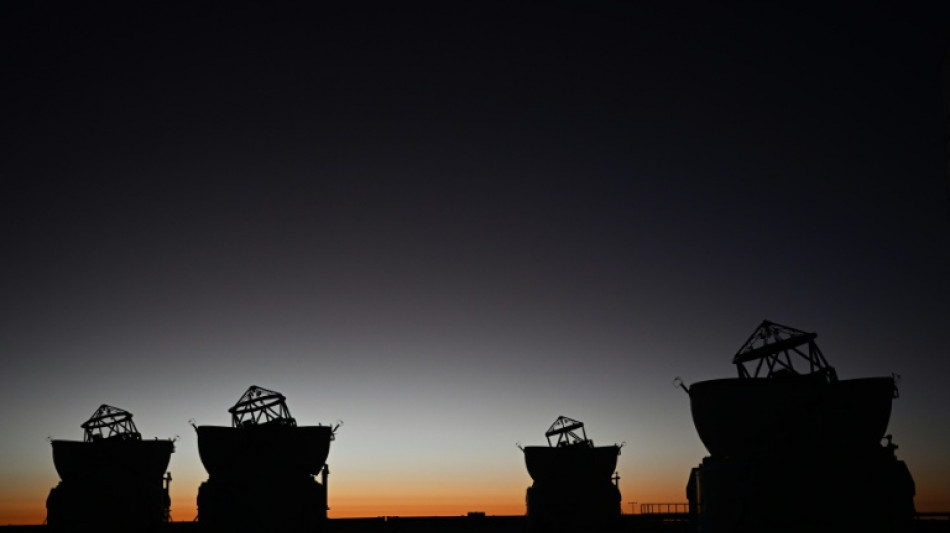
Europe observatory hails plan to abandon light-polluting Chile project / Photo: RODRIGO ARANGUA - AFP/File
Europe's ESO star-gazing organisation on Monday welcomed plans to call off building a massive green energy project in the Chilean desert which threatened to spoil its telescopes' view of the darkest skies on Earth.
AES Andes, a subsidiary of US energy company AES Corporation, in 2024 submitted proposals for the construction of a 3,000-hectare (7,400-acre) project in Chile's Atacama desert to generate solar and wind energy as well as green hydrogen.
The plans sparked alarm in the astronomical community over fears that light pollution from the project would interfere with the nearby Paranal Observatory's current and future telescopes.
The $10 billion Inna project had been waiting to hear the result of an environmental impact assessment.
However AES Andes announced late last month that it had "decided to desist from the execution of the Inna project" and instead focus on renewable energy and energy storage.
"When the cancellation is confirmed, we'll be relieved that the Inna industrial complex will not be built near Paranal," European Southern Observatory (ESO) director general Xavier Barcons said in a statement on Monday.
"Due to its planned location, the project would pose a major threat to the darkest and clearest skies on Earth and to the performance of the most advanced astronomical facilities anywhere in the world," he added.
Perched at 2,635 metres (8,645 feet) above sea level, and located dozens of kilometres from the nearest town of Antofagasta, Paranal's unique atmospheric conditions make it one of the most productive observatories in the world.
Analysis conducted by the ESO last year found that the Inna project "would have caused "severe, irreversible damage to the dark skies of Paranal", the organisation said.
For example, it would have increased light pollution above the Very Large Telescope, which is made up of four individual telescopes, by at least 35 percent.
Among other discoveries, the telescope produced the first ever image of an exoplanet -- a planet outside our solar system -- in 2004.
The plans would also have had an impact on the stadium-sized Extremely Large Telescope, which is scheduled to start scientific observations in 2029 with a budget of 1.45 billion euros ($1.7 billion).
"It has been incredibly reassuring to see so many people in Chile and around the world care deeply about, and actively speak up for, the protection of dark and quiet skies," Barcons said.
T.Parisi--RTC