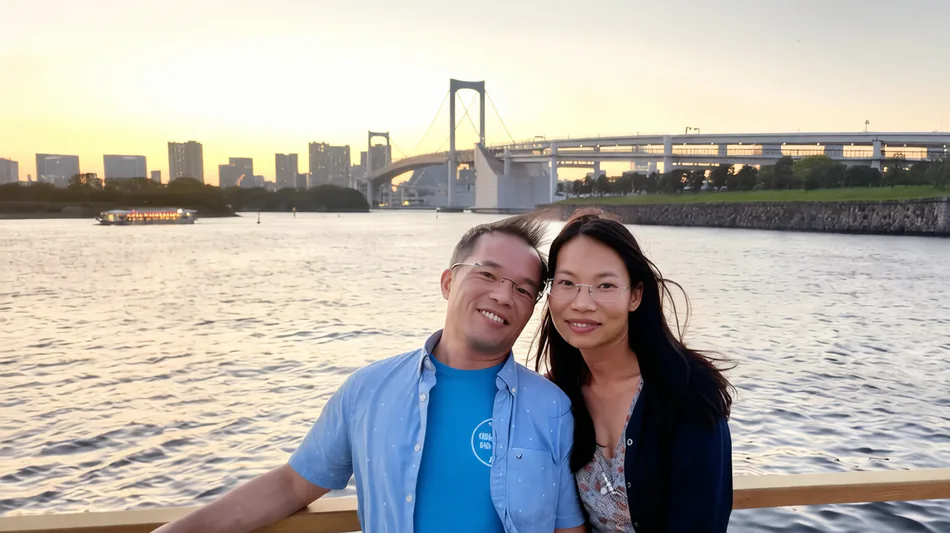
Australian Husband of Activist Abducted by Vietnam, Wife Urges Government Action
Chloe Dang is urging the Australian government to intensify efforts to secure the release of her husband, Tran Hiep, who was detained in Cambodia and subsequently held by Vietnamese authorities. Dang describes the incident as an abduction linked to Vietnam’s crackdown on dissidents and calls for immediate consular intervention.
Chloe Dang arrived at Bangkok’s Suvarnabhumi Airport in the early hours of September 20, driven by a desperate need for information regarding her missing husband, Tran Hiep. The Australian citizen was scheduled to land that morning on a flight from Cambodia, but he never appeared. For nearly ten days, Dang navigated a labyrinth of local police, tourist authorities, and immigration offices, only to receive confirmation from the airline that Hiep had never boarded the plane.
The disappearance marks a sharp and violent end to what Dang described as an ordinary family conversation just days prior. On September 18, the couple had discussed upcoming birthday celebrations for Hiep’s mother and niece in Australia. They were planning venues and logistics when they spoke by phone. Hours later, Dang sent a casual message about their home; it went unanswered. She assumed he was busy with work or delayed at his hotel. When he failed to arrive at the airport the next day, her hope that he would simply show up faded into a crisis.
Hiep, 51, is a long-standing member of Viet Tan, an international organization advocating for political change in Vietnam. The group, which engaged in armed resistance against the communist government in the 1980s before re-emerging as a political advocacy body in 2004, is designated as a "terrorist" organization by Hanoi. According to Human Rights Watch, Vietnamese authorities have continued to arrest and imprison members of the group despite its shift toward non-violent activism.
The circumstances surrounding Hiep’s detention remain contested. Nearly ten days after his disappearance, Vietnamese authorities acknowledged that Hiep, along with Norwegian activist Nguyen Duc Thuan and Vietnamese national Thai Cong Truong Son, had been detained while attempting to cross into Vietnam "illegally." Dang firmly disputes this characterization. She noted that Hiep, an Australian citizen, had previously traveled to Vietnam legally on a visa, while his Norwegian companion was exempt from visa requirements for stays up to 45 days.
"Why would he enter Vietnam illegally when he could go legally?" Dang asked, describing the official allegation as a pretext for detention. She argued that the claim of illegal entry did not align with the travel histories and legal statuses of the individuals involved.
Cambodia’s interior ministry also weighed in on the incident, stating on October 7 that Hiep and Thuan had entered Cambodia but there was no record of their departure from the country. The ministry "categorically" denied handing the two men over to Vietnamese authorities, raising questions about how they ended up in Vietnamese custody.
Elaine Pearson, Asia director at Human Rights Watch, described the disappearance as an "apparent abduction." In a statement, she emphasized that the detention of foreign nationals raised serious questions about the roles of both the Vietnamese and Cambodian governments. Pearson urged the Norwegian and Australian governments to press Vietnamese authorities for immediate access to their citizens and to drop what she termed "baseless charges."
Hiep has since received two visits from Australian consular officials, on October 15 and November 20, at a pretrial detention center in Ho Chi Minh City. Through these officials, Hiep sent a message describing himself as traumatized and struggling mentally. He denied crossing the border voluntarily or intending to enter Vietnam at all.
Following the second consular visit, Dang received updates regarding her husband’s physical condition. She reported that he was managing to look after himself and was doing well physically, though he remained deeply traumatized by the experience. The emotional toll on Dang has been severe; she described her mental health breaking down in the immediate aftermath of his disappearance, yet she maintained a glimmer of hope for his return until concrete evidence of his detention emerged.
The case is part of a broader pattern of alleged transnational repression by Vietnam. Activists claim that Hanoi is intensifying its crackdown on Viet Tan and other dissident groups, utilizing arrests, trials in absentia, abductions, and pressure on foreign nations to silence opposition. In 2019, Vietnamese authorities arrested Australian Viet Tan member Chau Van Kham and two local associates, sentencing them to lengthy prison terms on terrorism charges. While Kham was released in July 2023, his co-defendants remain imprisoned.
Historical precedents include the 2018 arrest of Le Quoc Binh in Binh Dinh province, who was accused of smuggling weapons from Cambodia for "terrorist activities." Viet Tan rejected these allegations at the time as "ridiculous fabrication." Vietnamese security agencies have also been accused of abducting dissidents in other countries, including Trinh Xuan Thanh, Truong Duy Nhat, and Duong Van Thai, in Germany and Thailand.
In the past year, Vietnamese courts have tried several overseas nationals in absentia, convicting and sentencing them to lengthy prison terms. Vietnam has also been accused of pressuring foreign nations like Thailand and Cambodia to return citizens who have fled due to fear of arbitrary arrest or torture.
Dang is now traveling across Europe to draw international attention to her husband’s detention. She emphasized that the involvement of Australian and Norwegian citizens highlights the global reach of these tactics. "This time we are talking about Australians and Norwegians," she said. "Next time it could be British, French, or anyone."
While Dang acknowledged the efforts of the Australian government, including Prime Minister Anthony Albanese’s decision to raise the case at the recent ASEAN summit in Manila, she argued that more action was needed. "But it has been two months already in this case," she said. "My husband got abducted, so I still want our government to do more to bring my husband back home safely soon."
Dang called for concrete steps to tackle transnational repression, noting that the issue extends beyond her personal tragedy. "We have to do something to stop it because it’s not just my husband. There have been many other cases recently, involving a lot of other people."
Vietnam’s embassy in Canberra rejected the allegation of abduction as "unfounded and misleading," maintaining that the men were arrested in accordance with the law. Viet Tan issued a statement condemning the events as a "grave violation of international law" and urged democracies, particularly Australia and Norway, to not tolerate such repression.
For Dang, the political dimensions of the case are intertwined with her memory of her husband as a person. She recalled him as "cheeky" and "funny," a man who loved music and played drums, guitar, and keyboard at family gatherings. Hiep moved to Australia at age 17 and co-founded a group campaigning against human trafficking while still a student.
"He’s a normal man. He’s a good husband and also a good son to his family," Dang said, emphasizing that being a human rights activist or helping others should not be a crime punishable by detention abroad.
Vietnam currently holds more than 160 political prisoners, according to activists, who allege they are detained for exercising free expression or advocating for democracy. In the first nine months of 2026, Vietnamese courts sentenced 31 activists to lengthy prison terms, including bloggers Hoang Thi Hong Thai and Huynh Ngoc Tuan. During the same period, police allegedly arrested 46 people for criticizing the government.
As Dang continues her campaign in Europe, the case remains a focal point for concerns about the extraterritorial reach of Vietnamese state power and the protection of citizens abroad.
P.Johnson--RTC