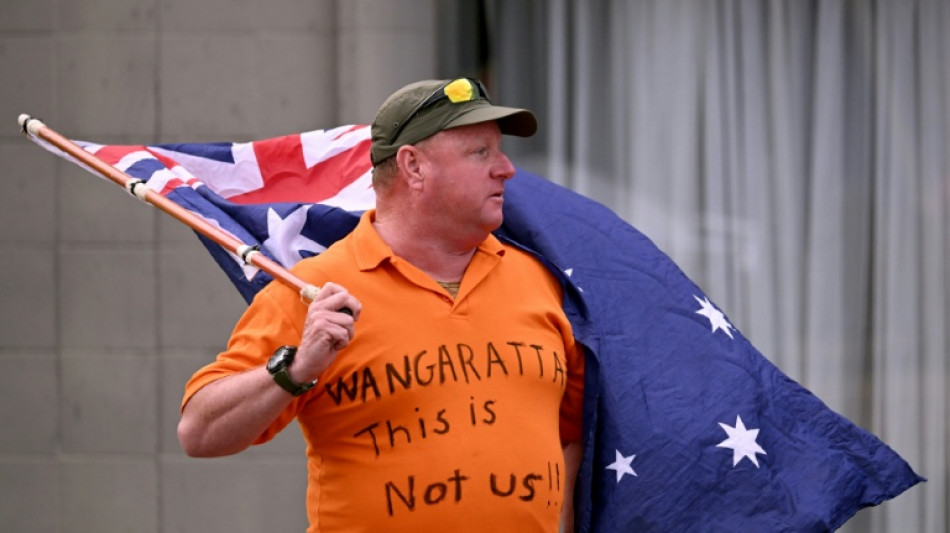
Threats of political violence soar in Australia's 'online echo chamber' / Photo: William WEST - AFP
Australia's security chiefs had warned of "online echo chambers" fuelling grievances and conspiracies and stepped up prosecutions for threats of political violence ahead of Monday's attack on a lawmaker in a rural town.
Independent lawmaker Helen Haines, 65, underwent surgery overnight but remains in a critical condition after being struck deliberately by a car in an attack that "does shake all of us", Prime Minister Anthony Albanese said Tuesday.
National broadcaster ABC and the Sydney Morning Herald reported she had lost a leg.
A man, 43, is in custody after Haines was hit outside her office in the town of Wangaratta, just over 200 kilometres (124 miles) northeast of Melbourne.
Police described it as an isolated incident with the motive under investigation by the counter-terrorism team.
Acts of political violence are rare in Australia, and Albanese told the national broadcaster he wanted the country to remain a place where lawmakers can engage with people, go shopping, and watch football.
But he said security needed to be "dealt with" amid a significant increase in threats.
Australia's Human Rights Commission said the attack happened "against a backdrop of increasing polarisation and threats against politicians", which could undermine democracy.
Threats against Australian lawmakers and electorate offices doubled between 2021 and 2025, with 1,067 incidents reported to police last year.
The Australian Federal Police formed a National Security Investigations team last October, described by police commissioner Krissy Barrett as a "flying squad of hate disruptors", resulting in 41 people being charged for threats against federal politicians, ministers, and the prime minister.
Just this month, three men were charged by police over separate threats to politicians and government officials, and another three were sentenced by courts.
The nation's spy chief, Australian Security Intelligence Organisation director-general Mike Burgess, warned last year politically motivated violence was among the agency's fastest growing security concerns, driven by "grievance narratives, conspiracies and online echo chambers".
Political intolerance, violent rhetoric and polarisation were also contributing to a "permissive environment of violence", Burgess said on Tuesday.
Australia's Human Rights Commission said the attack happened "against a backdrop of increasing polarisation and threats against politicians" which could undermine democracy.
The lawmakers targeted are across the political spectrum and include men.
But the nature of threats directed at female lawmakers is "particularly troubling" because they are targeted because they are women, the federal police said last year.
The University of Melbourne's associate head of psychological sciences, Lisa Phillips, said she was not surprised it was a female lawmaker who had been attacked.
Victoria's state parliament commissioned Phillips to survey lawmakers on online abuse and stalking five years ago.
"The female politicians who responded almost ubiquitously reported experiences of either unwanted approaches, persistent unwanted contact from people, or experiences of threats or of assault," she told AFP.
Eighty-five percent of the threats received by the Victorian women lawmakers were gender-based abuse, the study found.
The attack on Haines may not be linked to federal politics, Phillips added.
"If you have a grievance against the system, you don't care which part of the system you are targeting."
J.Morris--RTC