Asian allies stress 'critical cooperation' as Trump slashes Korea drills / Photo: HILARY WARDAUGH - AFP
Japan underlined on Tuesday that security cooperation with the United States and South Korea was "critical" for the region's stability, after President Donald Trump alarmed allies by scaling back military drills with Seoul while hailing his ties with Pyongyang.
Trump abruptly announced on Sunday that he had ordered the Pentagon to scale back "inappropriate and hostile" military drills with South Korea.
The following day he insisted he was making the situation "much safer" through his ties with the North's Kim Jong Un, whom he met three times in his first term but has yet to encounter since his return to the White House.
While praising the leader of nuclear-armed North Korea, he rebuked key ally Seoul for failing to help Washington fight Iran -- a war Trump says is aimed at stopping Tehran from getting an atomic bomb.
Pressed about whether Kim had responded to his messages, Trump told reporters in the Oval Office: "Yeah, he has."
Trump said "it's very positive" when asked what stage the conversations with Kim were at, but provided no further detail.
He then doubled down on his praise for Kim, saying their ties reduced tensions.
"Kim Jong Un has always treated me with great respect," Trump said. "I understand him. He understands me."
- 'Critical' cooperation -
The 11-day Ulchi Freedom Shield exercises with South Korea are designed to prepare for a possible war with North Korea, which decries the drills as dress rehearsals for an invasion.
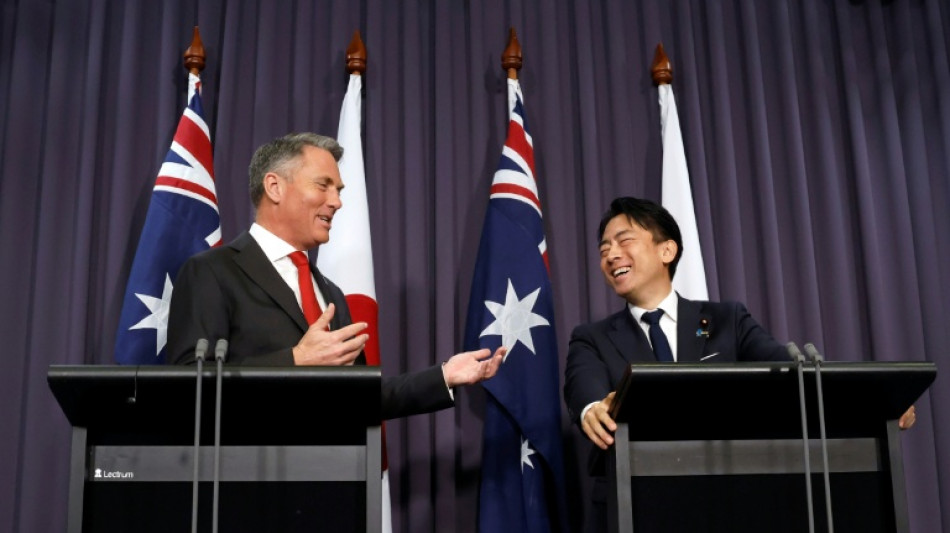
Japanese Defence Minister Shinjiro Koizumi strongly supported joint security cooperation with key defence backer Washington and neighbour Seoul.
"As Japan faces the most severe and complicated security environment in the post-war era, the cooperation among Japan, the United States and South Korea is critical to the peace and stability of the region," Koizumi told journalists during a visit to Australia.
His Australian counterpart Richard Marles said Canberra was "very concerned about North Korea's nuclear programme as well as its missile programme, and we have consistently made that point".
South Korean officials have said the exercises had begun as planned and that they hoped the personal chemistry between Trump and Kim would bring them back to talks.
Seoul's presidential office said on Tuesday the drills did not reflect "any intention to attack North Korea or escalate tensions on the Korean peninsula".
However, its unification ministry -- responsible for relations with the North -- said it could not confirm whether communications between Kim and Trump had taken place.
"While communication channels between the two sides exist, we cannot verify the specific content of the exchanges," a spokesperson said.
Trump again called into question on Monday US support for both South Korea and NATO allies that have refused to contribute to the Iran war.
"Wait a minute. We have 39,000 soldiers over there, guarding you from Kim Jong Un, your next-door neighbour, and you're not going to help us on a very easy military operation in Iran. That's strange," Trump said in the Oval Office.
"We can't go around and protect all of these countries, especially when they're not there to help us," he said.
North Korea has not responded publicly, although it has previously voiced anger at the regular joint manoeuvres that take place in the South.
- Shaky alliances -
The United States stations about 28,500 troops in South Korea to bolster the country's defences, a legacy of the 1950-53 Korean War that ended with an armistice rather than a peace treaty.
However, Trump's repeated criticism of time-honoured alliances has cast doubt on US commitments to security in East Asia.
The announcement of the scaled-down drills came as the only US aircraft carrier operating in the Pacific region, the USS George Washington, is being redeployed to the Middle East to relieve the USS Lincoln.
The Lincoln has been the focus of concerns over crew mental health and supply issues after a long deployment.
US partners across the region are under pressure to spend more on their militaries, including Taiwan, which Beijing claims is part of its territory and has threatened to use force to annex.
The island's President Lai Ching-te pledged on Monday record defence spending for 2027.
Under intense US pressure to cough up more on security, Lai's government has vowed to increase defence spending to five percent of GDP by 2030.
burs-oho/pbt
W.Guerrero--RTC