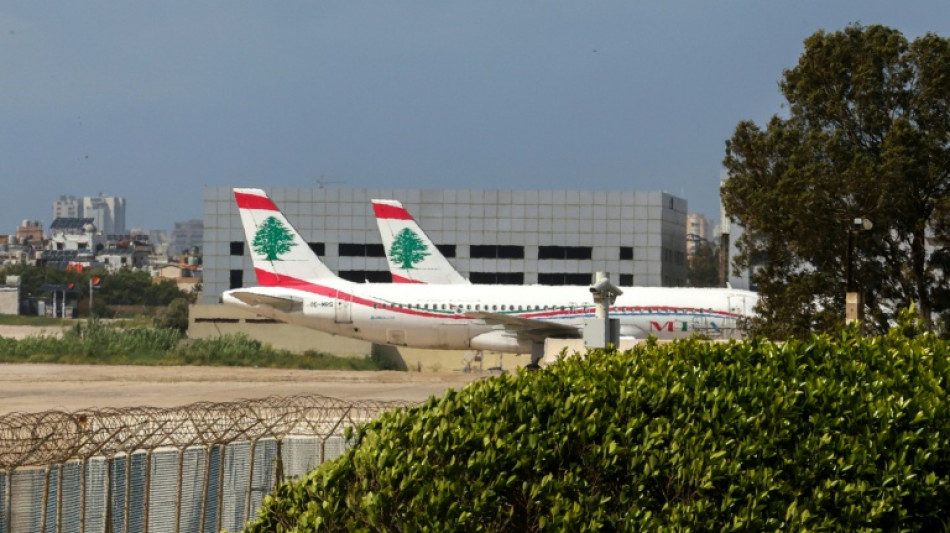
Planes fly from Beirut airport despite Israeli bombing / Photo: Anwar AMRO - AFP
Smoke from an Israeli strike still lingered in the air as a plane from Lebanon's national carrier took off from Beirut airport, which has stayed open despite the latest war between Israel and Hezbollah.
The country's only international passenger facility, whose departure boards are now largely red with cancellations, is located on the Mediterranean coast at the edge of Beirut's southern suburbs.
Israel has pummelled the southern suburbs, a Hezbollah stronghold, with strikes since the Iran-backed group fired rockets at Israel last month, drawing Lebanon into the Middle East war.
"The airport has stayed open throughout this crisis" following risk assessments based on information received "mainly from the US embassy", said Mohammed Aziz, head of Lebanon's civil aviation authority.
He said authorities received additional guarantees this week that the airport would be spared, after Israel on Thursday issued an evacuation warning for large areas of southern Beirut, including the main road leading to the facility and areas directly adjacent.
Israel has so far not carried out its threat, which came a day after devastating strikes across the country, including on central Beirut and its southern suburbs, killed more than 350 people.
AFP images showed a flight by Lebanon's Middle East Airlines (MEA), whose logo is the country's beloved cedar tree, landing on Thursday evening just hours after the warning was issued.
Israel and Hezbollah also waged a full-blown war in 2024, and then too the airport stayed open and MEA kept flying.
- 'Specific air routes' -
Aziz, who is also a former pilot, said the airport was seeing less than half the traffic it normally would at this time of year.
Most airlines have suspended trips to Beirut, with MEA keeping up a reduced number of flights, including three a day to Turkey, compared to 11 normally.
On Friday, just a few dozen travellers were in the usually packed departures hall, as porters sat on empty baggage carts and soldiers kept watch at the terminal entrance.
Staring at the departures board, Mohammed Assaad, 48, an Australian of Lebanese origin who was heading back to Sydney via Cairo, said he was unfazed by the Israeli bombardment.
"I'm just hoping that our flight won't be cancelled. That's all I'm worried about," said Assaad, who was travelling with his wife and two daughters.
Commercial planes are in the skies at the same time as Israeli military aircraft, including drones, but they travel along different air corridors, an MEA pilot told AFP.
"We have very specific air routes," he said, and "the Israelis know where our planes are -- our transponders are turned on", he said on condition of anonymity.
- 'Open and operational' -
Israeli military aircraft including drones generally fly at higher altitudes than commercial planes, he said, while such aircraft also show up on commercial planes' radars.
There is little chance of Israel's military somehow bringing down "a plane by accident", he added.
To manage traffic and avoid any incidents, "the Americans are the main intermediaries", the pilot said.
Civil aviation authority chief Aziz said that "only on two or three occasions maximum" a commercial plane delayed a landing due to Israeli military action.
A Western diplomatic source told AFP that Lebanese authorities were sharing information on flight movements with some other diplomatic missions in the country.
"The Lebanese are working around the clock to guarantee the security of the airport," the source said, requesting anonymity.
Jalal Haidar, a Lebanese-American who took over as the airport's chief operating officer two months ago, also expressed full confidence in the airport, its surroundings and the airspace.
"All three are safe," said Haidar, who formerly managed airports in the United States.
He said the facility was taking advantage of the lower passenger numbers to push forward with renovations so that the site, which handles an average of eight million passengers annually, can accommodate up to an extra 1.3 million this year.
"We are prepared to remain open and operational," he said.
"We are also driven by our determination to keep Lebanon connected to the rest of the world."
A.Olsson--RTC