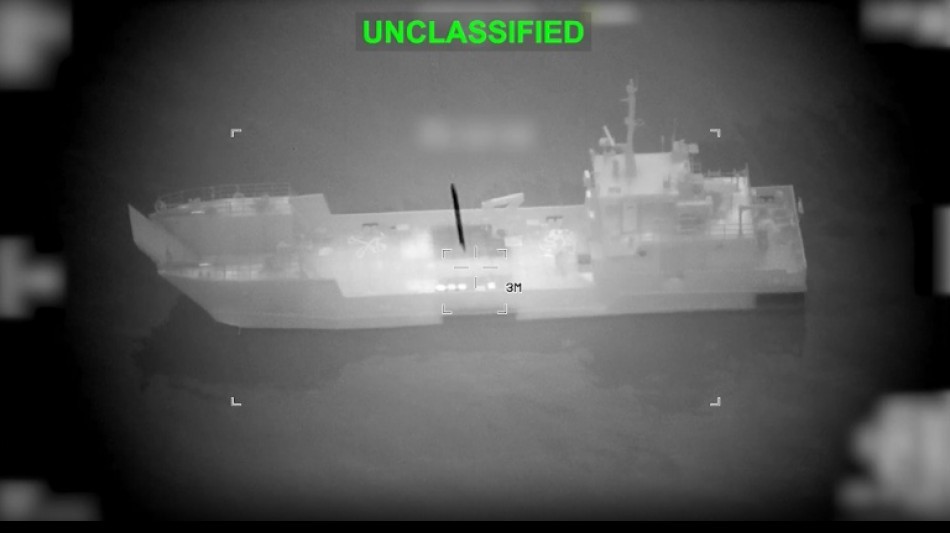
Trade ships hit as Iran threatens Gulf oil chokepoint / Photo: - - US Central Command (CENTCOM)/AFP
New attacks hit three commercial ships in the Gulf on Wednesday, with one of the vessels in flames as Iran pressed its campaign against its oil-exporting neighbours, threatening shipping in the Strait of Hormuz and plunging the global energy economy into crisis.
Oil prices surged higher by more that five percent in early trading and markets have see-sawed since the end of last month, when the United States and Israel attacked Iran, killed its supreme leader and plunged the Middle East into war.
As the conflict entered its 12th day, the Iranian military vowed to target "economic centres and banks" linked to US and Israeli interests, and all eyes were on the vital sea lane.
The leaders of the G7 powers were to hold a video meeting later to discuss opening their strategic petroleum reserves to counter rising prices. Ahead of the talks, the group's energy ministers said they "stand ready to take all necessary measures" in coordination with the International Energy Agency (IEA).
Japan is ready to take the lead and release its oil reserves as early as Monday, without waiting for an IEA decision, Prime Minister Sanae Takaichi said.
Analysts say a prolonged closure of the Strait of Hormuz, which carries 20 percent of world oil and gas supplies and a third of its fertiliser for food production, would have a devastating effect on the world economy, particularly in Asia and Europe.
On Tuesday, the Pentagon said US forces had carried out strikes that destroyed 16 mine-laying vessels that could have been used to block the strait, but attacks with drones or missiles continued on Wednesday with at least three ships hit.
"If for any reason mines were placed, and they are not removed forthwith, the military consequences to Iran will be at a level never seen before," US President Donald Trump posted on social media.
Turkey's President Recep Tayyip Erdogan called on the warring parties to negotiate a ceasefire, an idea already rejected by senior Iranian leaders, while Israel said it had begun a new "wide-scale wave of strikes" across Iran and against Hezbollah targets in Lebanon's capital Beirut.
"This war must be stopped before it becomes bigger and completely engulfs the region in flames," Erdogan said, describing the Middle East as "once again enveloped in a smell of blood and gunpowder".
- Airport hit -
According to the UK maritime security centre the crew of a cargo vessel in the Strait of Hormuz north of Oman was forced to evacuate when an "unidentified projectile" caused a fire on board.
Separately a bulk carrier and a container ship were hit in the Gulf off the United Arab Emirates.
The Thai navy said the bulk carrier Mayuree Naree "was attacked while transiting the Strait of Hormuz".
"Efforts are currently underway to rescue the remaining three crew members," while 20 were rescued by the Omani navy, it said, adding that the cause of the attack was under investigation.
On shore, drones fell near Dubai airport, injuring four people, the city's government said.
Trump has said the US Navy could accompany tankers through the strait, but experts were dubious about whether naval escorts would be enough to reopen Hormuz to trade.
"Any escort mission would likely face persistent threats from Iranian missiles and drones, and the security risks alone could make a single transit through the strait more costly than the profit margin on the oil shipment itself," the Soufan Center think tank said, in a briefing note.
"Experts estimate that Iran's naval mine stockpile sits anywhere from 2,000 to 6,000 mines, which would further complicate any naval plan to escort commercial tankers," it said.
- 'Not seeking ceasefire' -
The Israeli-US attacks came weeks after Iranian authorities ruthlessly crushed mass protests, although the United States and Israel say they are not necessarily seeking to topple the Islamic republic.
Iranian authorities warned against dissent at home, with the country's police chief saying protesters would be viewed and dealt with as "enemies".
"All our forces are also ready, with their hands on the trigger, prepared to defend their revolution," national police chief Ahmad-Reza Radan said, in comments aired by IRIB.
In Iran, ordinary people were doing the best they could to adapt to living under frequent US-Israeli strikes.
"We've put our faith in God. For now, there's food in the shops; every day I go to buy greens and bread, that's all," Tehran resident Mahvash, 70, told AFP journalists in Paris.
"People are calm," said another resident. "They are getting used to living despite everything and adapting -- as best they can -- to this situation."
- Ayatollah 'safe and sound' -
The United States and Israel launched the war on February 28 with an attack that killed Iran's veteran leader, Ayatollah Ali Khamenei.
His son Mojtaba Khamenei has been named his successor, though he has yet to appear in public, amid reports that he has been wounded.
"I heard news that Mr Mojtaba Khamenei had been injured. I have asked some friends who had connections. They told me that, thank God, he is safe and sound," said Yousef Pezeshkian, son of Iran's president, in a post.
Iran's health ministry said on March 8 that more than 1,200 people had been killed in US and Israeli strikes, and more than 10,000 civilians injured. AFP was not in a position to independently verify the figures.
Iraq and Lebanon, both home to Iran-backed fighters, have become proxy grounds in the war.
In Lebanon, authorities reported 570 people killed and hundreds of thousands of displaced following Israeli air strikes and ground operations targeting Iran-backed Hezbollah.
New Israeli strikes were reported in Beirut's southern suburbs on Wednesday, while an attack also hit a building in the heart of the capital.
burs-dc/ser
Ch.Jacobs--RTC