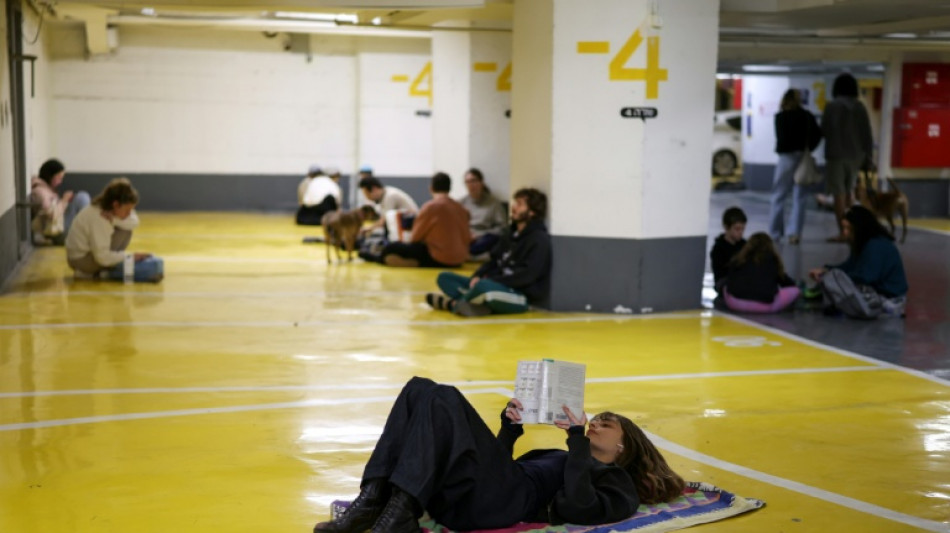
Israelis shelter underground as Iran fires missiles / Photo: Ilia YEFIMOVICH - AFP
Across Israel, city streets stood deserted on Saturday as residents took cover in shelters, while the blasts from Iranian missiles being intercepted reverberated overhead.
It was the second time in under a year that Israelis were undertaking this grim wartime routine, having first fled Iranian missiles during a 12-day war between the arch-foes last June.
The United States and Israel launched a wave of strikes against military targets in Iran on Saturday, sparking a rapid Iranian retaliation towards Israel.
In the commercial hub of Tel Aviv, Orit Baisa, 42, rushed to an underground car park as soon as he heard the air raid sirens warning of an incoming missile barrage.
"We don't have a shelter, no safe room. The stairwell isn't a compliant secure room. This (car park) is the safest place there is," he said.
"If this (war) is going to last, then yes, sure, we'll go back to it, bring the tents, the mattresses, bring all the equipment and live here, like last time", he told AFP.
Andrea Siposova, who fled to the same car park, told AFP she had prepared for the shelter in case war broke out.
"We were already prepared with our emergency backpacks in case this happens. And yeah, so once we got the alert that there is a missile attack, we came to the shelter", said Siposova, a 31-year-old originally from Slovakia who now lives in Tel Aviv.
Roi Elba came to the shelter with his dog Gaia to wait out a missile salvo.
"It's the place to be when it's unsafe outside. Most of the buildings, most of the apartments in Tel Aviv, in the centre of Tel Aviv, don't have a safe room, shelter".
- Assault rifles and strollers -
Inside, some people had brought prams, others, who were reservists, their assault rifles while some began praying in a small group.
Several dogs were there, too, hunkering down with their owners.
Outside of the car park, white trails scarred the blue sky as Israel's air defence system launched into action to detonate Iranian missiles before they could land, an AFP journalist reported.
Further north on Israel's coast, a projectile lifted a large blast of water in Haifa Bay as it exploded in the Mediterranean Sea, water and smoke rising high above a nearby commercial ship, an AFP photojournalist reported.
After a projectile struck a building in the nearby city of Tirat Carmel, residents were evacuated, according to the same journalist.
Israel's first responders agency, Magen David Adom instructed its ambulances to use sirens as little as possible, so as to avoid people confusing the sound for that of air raid sirens, it said in a statement.
By mid-afternoon on Saturday, it had reported only one mild injury linked to missiles, a 50-year-old man injured by a blast in Israel's north.
All other national agencies also sprang into wartime mode, with the education ministry cancelling all classes and the aviation authority halting all flights in and out of the country.
In Jerusalem, the streets were mostly empty, with residents staying home or close to shelters.
There too, numerous blasts broke the stillness of the empty streets as barrages came one after the other, sometimes rattling windows as missiles detonated overhead.
- 'Trapped' -
In the nearby West Bank city of Ramallah, 15 kilometres north of Jerusalem, Palestinians mostly carried on with life as usual, with markets in full swing and conversations only occasionally interrupted by overhead blasts.
"There have been wars since our great-great-grandparents' time. Nothing concerns us. Our lives must continue as normal", Ghazala Arar, a resident of the nearby Jalazone camp, told AFP.
For most, the main inconvenience remained the Israeli military's closure of many of the hundreds of checkpoints that restrict movement in the Palestinian territory, locking some people out of their homes.
"I'm trying to go to Jenin, but all the checkpoints are closed. The attack happened in an instant -- we are trapped here", Rajwa Atatra, who had come to Ramallah from the northern city of Jenin to visit her brother, told AFP.
A.Jonsson--RTC