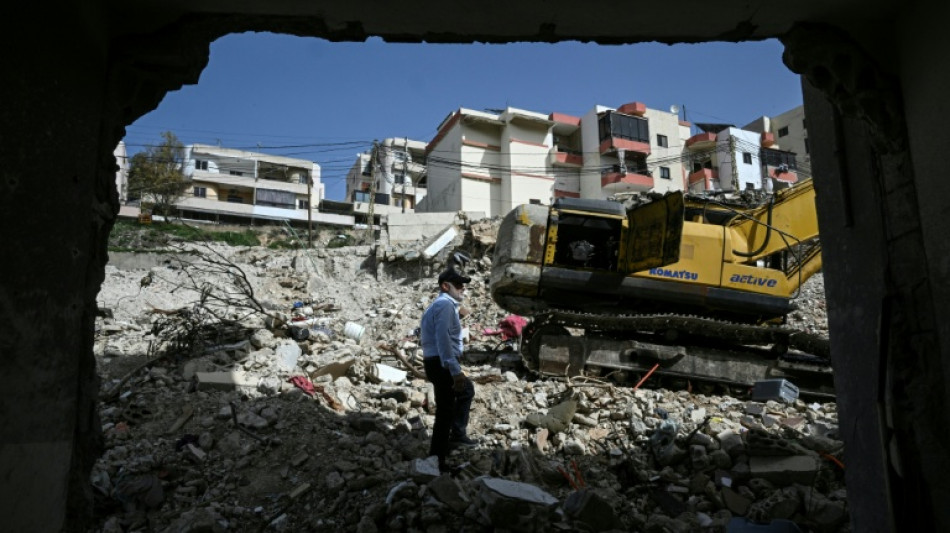
Lebanon fears Israeli strikes if Iran situation escalates / Photo: Joseph EID - AFP
Lebanon's foreign minister said Tuesday his country fears its infrastructure could be hit by Israeli strikes if the situation with Iran escalates, after Israel intensified its attacks on Tehran-backed Hezbollah.
With tensions high, Lebanon's army accused the Israeli military of firing near a position it was setting up in the country's south, saying it had instructed troops to return fire.
"There are signs that the Israelis could strike very hard in the event of an escalation, potentially including strategic infrastructure such as the airport," foreign minister Youssef Raggi told reporters in Geneva.
His comments came against the backdrop of a massive US military buildup in the Middle East that suggests Washington is prepared to wage a sustained campaign against Iran.
On Monday, Iran vowed to retaliate "ferociously" against any attack from the United States, and repeated its warning of a regional conflagration in response to President Donald Trump's latest threat of strikes.
"We are currently conducting diplomatic efforts to request that, even in the event of retaliation, Lebanese civilian infrastructure not be targeted," Raggi said.
The Lebanese minister stressed that his country's leadership had been very clear: "This war does not concern us."
A Lebanese official who requested anonymity said "what the Lebanese fear is a chain reaction: an American strike against Iran, a Hezbollah retaliatory strike against Israel, followed by a massive Israeli response."
In a post on X, Raggi said he hoped "Hezbollah refrains from entering any new adventure and spares Lebanon further destruction".
"We have received warnings indicating that any intervention on its part could prompt Israel to strike infrastructure, and we are working through all means to prevent that," he added.
- Israeli strikes -
Israel has kept up regular strikes on Lebanon despite a November 2024 ceasefire that sought to halt more than a year of hostilities with Iran-backed Hezbollah, usually saying it was targeting the group.
Last Friday, Israel carried out deadly strikes on what it called Hezbollah positions in eastern Lebanon and targets linked to the Palestinian group Hamas in the south.
Hezbollah said Saturday that eight of its fighters had been killed, and vowed "resistance".
Its leader Naim Qassem stated last month that any attack on Tehran would also be an attack on Hezbollah.
On Monday, Washington ordered non-emergency personnel to leave its embassy in Lebanon's capital Beirut, as anticipation rose of a possible conflict with Iran.
On Tuesday, Lebanon's army said it was "establishing a new observation post on the southern border" when "the area surrounding the post was subjected to gunfire from the Israeli side".
"The army command issued orders to reinforce the post, remain there, and return fire."
Israel's military said it had spotted Lebanese soldiers establishing the post adjacent to Israeli troops "without prior coordination," and requested they stop.
"After the request went unanswered, the troops conducted warning fire in order to halt the work," the military said in a statement.
- Cairo meeting -
Also on Tuesday, a preparatory meeting was held in Cairo ahead of a conference in Paris next month to back Lebanon's army, which is facing heavy pressure from Washington and Israel to disarm Hezbollah.
At the meeting, Egyptian Foreign Minister Badr Abdelatty called for the international community to better support Lebanon's armed forces.
The meeting aimed "to enable the Lebanese state to ensure that all weapons are held exclusively by the state," Abdelatty added.
Last year, Lebanon's government committed to disarming Hezbollah, which was badly weakened in a recent war with Israel, and tasked the army with drawing up a plan to do so.
The army, which has limited capabilities, declared in January the completion of the first phase of its plan near the border with Israel.
It said last week it would need at least four months to complete the second phase.
Israel, which accuses Hezbollah of trying to rearm, has criticised the army's progress as insufficient.
C.P.Wilson--RTC