US says will match alleged Chinese low-yield nuclear tests / Photo: © US DEPARTMENT OF ENERGY/AFP/File
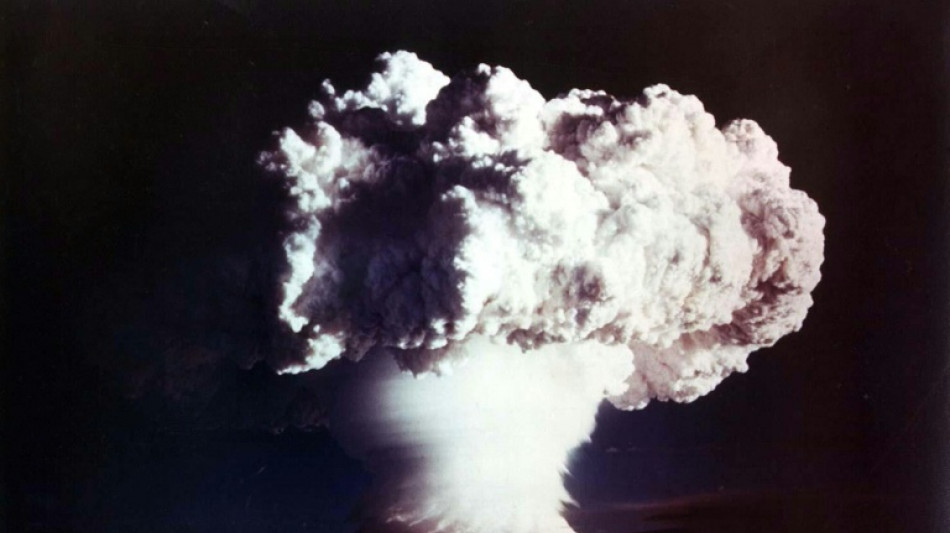
The United States is ready to carry out low-yield nuclear tests to match alleged secret explosions by China and Russia, ending a decades-old moratorium, a senior official said Tuesday.
New START, the last treaty between the United States and Russia that limited deployment of nuclear warheads, expired this month as US President Donald Trump called for a new agreement that also includes China.
Christopher Yeaw, the assistant secretary of state for arms control and nonproliferation, indicated that Trump was serious when he said in October, without giving details, that the United States would resume nuclear testing.
"As the president has said, the United States will return to testing on a -- quote -- 'equal basis,'" Yeaw said at the Hudson Institute, a think tank.
"But equal basis doesn't mean we're going back to Ivy Mike-style atmospheric testing in the multi-megaton range, as some arms control folks would have you believe, hyperventilating about this issue," he said, referring to a massive 1952 thermonuclear detonation in the South Pacific.
"Equal basis, however, presumes a response to a prior standard. Look no further than China or Russia for that standard," he said.
He did not announce timing, saying Trump would make a decision, but added that any test would be at a "level playing field."
"We're not going to remain at an intolerable disadvantage," he said.
China's nuclear arsenal remains far smaller than those of Russia and the United States but it has been growing quickly. China has publicly rejected calls to enter negotiations on a new three-way treaty.
- Doubling down on China -
Another senior US official, at a UN meeting in Geneva as New START expired, accused China of carrying out a low-yield nuclear test in 2020 and of preparing more explosions with larger yields.
China said the allegations were "outright lies" and a pretext for the United States to resume nuclear testing.
The State Department in 2024 also alleged low-yield tests by Russia, which has issued veiled threats of using nuclear weapons in its invasion of Ukraine.
Yeaw stood by the charges on China, saying data gathered in nearby Kazakhstan on June 22, 2020 at 0918 GMT showed a 2.75-magnitude explosion, whose impact was likely muffled by taking place in a large underground cavity.
"There is very little possibility, I would say, that it is anything but an explosion, a singular explosion," he said, dismissing the possibility of an earthquake or mining incident.
In a recent report, the Center for Strategic and International Studies did not find conclusive evidence of an explosion, saying satellite imagery did not show unusual activity at Lop Nur, China's historic testing site in the western region of Xinjiang.
After the US allegations of the Chinese test, Robert Floyd, executive secretary of the Comprehensive Nuclear-Test-Ban Treaty Organization, said the international body also "did not detect any event consistent with the characteristics of a nuclear weapon test."
But he said the group's monitors can only observe explosions when they reach the equivalent of 500 tonnes of TNT -- a small fraction of the US bombs that flattened Hiroshima and Nagasaki in 1945 in history's only nuclear attacks.
Yeaw heaped scorn on the statement by Floyd, an Australian scientist, saying he should "reassess priorities" from urging an entry into force of the Comprehensive Test Ban Treaty if his staff cannot notice low-yield tests that nonetheless give knowledge to nuclear states.
"The treaty becomes basically a fig leaf," Yeaw said.
The UN treaty -- which would ban all nuclear explosions -- has not come into force, with France and Britain the only nuclear weapons states to have ratified it.
Former president Bill Clinton signed the treaty but it was rejected in 1999 by the Senate due to opposition from Trump's Republican Party.
The United States last test-detonated a nuclear bomb in 1992. It has since carried out "subcritical" experiments meant to ensure safety without reaching the level to trigger a nuclear chain reaction.
D.Nielsen--RTC