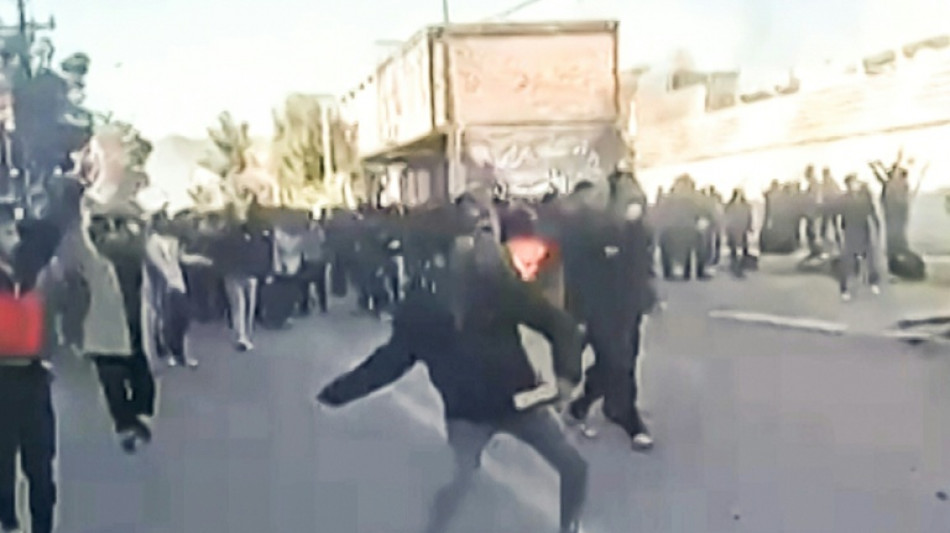
Iran's protests: What we know / Photo: - - UGC/AFP
Iran has been rocked this week by protests that started in Tehran and have spread to other cities, with at least six people killed in clashes with security forces.
Official media has largely played down the protests but videos have flooded social media, many of which are difficult to authenticate, or have even been manipulated.
Here is a recap of what we know and what analysts think it all means.
- What's going on? -
The protests began on Sunday in Tehran, where some shopkeepers went on strike over high prices and economic stagnation.
Iran's economy has been battered by years of crushing international sanctions over its nuclear programme, with raging inflation and a collapsing currency.
By Tuesday, student protests erupted at universities in the capital Tehran and the central cities of Isfahan and Yazd. Some merchants in the capital's bazaar joined in.
Demonstrations have now affected 20 areas, mostly towns in the west of the country, according to an AFP tally of official and local Iranian media reports.
In the southern city of Fasa, dozens of people protested outside a government building, lobbing projectiles and seeking to tear down its gate, according to videos posted on Wednesday, whose location AFP verified.
Slogans heard at protests now include "Death to the dictator" and "Woman, Life, Freedom", the US-based Human Rights Activists News Agency (HRANA) says, citing verified videos and reports. AFP was not immediately able to authenticate these soundbites.
The same chants were used in mass demonstrations after the September 2022 death in custody of Mahsa Amini, an Iranian-Kurdish woman arrested for allegedly breaching the country's dress code for women.
But authorities stamped out the 2022-2023 protests, using mass arrests and executions as part of its levers of repression, rights activists say. The system in charge since the 1979 revolution stayed in place.
- What's the context? -
"The protesters are very clear in their slogans -- they are not looking for reform," said US-Iranian human rights lawyer Gissou Nia, of the Atlantic Council.
They come as "the Islamic republic is dealing with a range of pressures, not only internally but also externally", she said.
Regional arch-foe Israel and the United States in June pounded Iranian nuclear sites and killed top military brass during a 12-day war.
On Monday, US President Donald Trump told Israeli Prime Minister Benjamin Netanyahu in Florida that if Tehran rebuilt its nuclear facilities, the United States would "knock them down."
Trump said on Friday the United States was "locked and loaded" to respond if Iran killed protesters.
Iran has also been weakened following major blows dealt to its regional allies, including in Gaza, Lebanon and Syria.
Some Iranians hold long-standing resentment that Tehran has given too much financial or military support to its regional proxies, such as Lebanese movement Hezbollah, during economic hardship at home.
Iran International, a television channel based outside Iran that is critical of the authorities, has reported that recent protest slogans included "Neither Gaza nor Lebanon, my life for Iran."
- How have authorities reacted? -
Protesters and security forces clashed in several Iranian cities on Thursday, with six reported killed, the first deaths since the unrest escalated.
Schools, banks and public institutions were closed on Wednesday for a public holiday, with officials saying this was due to the cold weather and to save energy.
But authorities have also recognised the grievances as legitimate, and announced a series of measures, including replacing the central bank governor.
President Masoud Pezeshkian, a reformist, said on Thursday that he and his government would "end up in hell", in the religious sense, if they failed to address economic hardship.
"The government knows that merchants are the lifeblood, the beating heart of Iran's economy, and therefore it is obliged to take measures to address, at least partially, the big issues," French-Iranian sociologist Azadeh Kian told AFP.
But supreme leader Ayatollah Ali Khamenei, 86, has yet to speak publicly on the matter.
- How big is it? -
Opposition abroad have welcomed the new protests.
Reza Pahlavi, the son of Iran's ousted shah, on X hailed 2026 as "the definitive moment for change", while the National Council of Resistance in Iran said Iranians wanted to "free themselves from the scourge of religious tyranny".
But Kian said today's protests were not as large-scale as previous demonstrations sparked by economic grievances, including those of 2019. They were sparked by a petrol hike, spreading to around 100 cities and towns, and left hundreds dead, according to rights groups.
"I very much doubt the current rallies could bring down or overthrow the regime," she said.
Arash Azizi, a postdoctoral associate and lecturer at Yale University, said the demonstrations however remained "the most serious wave of protests since 2023".
"It is clear that with ever declining standards of living and growing discontent, (the government) will have to face periodic protests," he said.
Ch.Jacobs--RTC