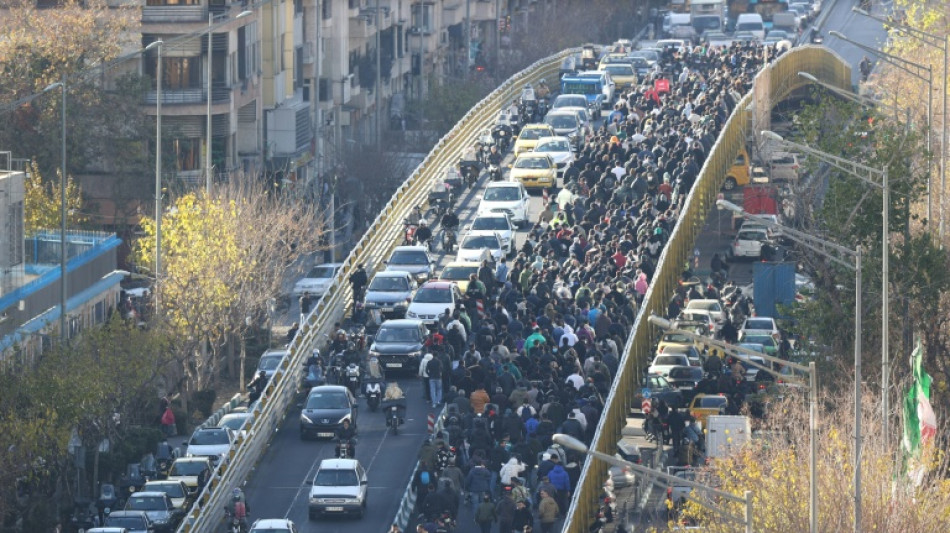
Tehran shopkeepers shut stores over economic conditions / Photo: HANDOUT - FARS NEWS AGENCY/AFP
Some shopkeepers in Tehran shut their stores for the second day in a row Monday in protest against economic hardships and sharp swings in Iran's embattled currency, media reports said.
The rial has hit new lows on the unofficial market, with the US dollar trading at around 1.42 million rials on Sunday -- compared to 820,000 rials a year ago -- and the euro nearing 1.7 million rials, according to price monitoring websites.
The rates eased somewhat on Monday, with the dollar at around 1.39 million rials, and the euro at about 1.64 million rials.
A journalist from the pro-labour news agency ILNA reported "demonstrations" at several bazaars in the centre of the capital on Monday, the agency said.
It said protesters "are demanding immediate government intervention to rein in exchange-rate fluctuations and set out a clear economic strategy".
Price fluctuations are paralysing the sales of some imported goods, with both sellers and buyers preferring to postpone transactions until the outlook becomes clearer, AFP correspondents noted.
"Continuing to do business under these conditions has become impossible," ILNA quoted protesters as saying.
State news agency IRNA reported: "Many shopkeepers preferred to suspend sales in order to prevent potential losses."
It added that some protesters on Monday "chanted slogans".
The conservative-aligned Fars news agency released images showing a crowd of demonstrators occupying a major thoroughfare in central Tehran, known for its many shops.
Another photograph appears to show tear gas being used to disperse protesters.
"Minor physical clashes were reported... between some protesters and the security forces," Fars said, warning that such gatherings could lead to instability.
- Judicial warning -
On Sunday, the ISNA news agency said a group of shopkeepers and mobile phone vendors at a main shopping centre in the city "protested against sharp fluctuations in the exchange rate and the damage caused to the mobile phone market" by briefly shutting up shop.
On Monday, Iranian Chief Justice Gholamhossein Mohseni Ejei called for "the swift punishment of those responsible for currency fluctuations", the justice ministry's Mizan agency reported.
The government has also announced the replacement of the central bank governor.
"By decision of the president, Abdolnasser Hemmati will be appointed governor of the Central Bank," presidency communications official Mehdi Tabatabaei posted on X.
Hemmati is a former economy and finance minister who was dismissed by parliament in March because of the sharp depreciation of the rial.
On Sunday, President Masoud Pezeshkian delivered the budget for the next Persian year to parliament, vowing to fight inflation and the high cost of living.
Notably, the budget provides for a 20 percent increase in wages, a rate that is nonetheless well below that of inflation.
In December inflation stood at 52 percent year-on-year, according to official statistics. But this figure still falls far short of many price increases, especially for basic necessities.
Iran's economy, already battered by decades of Western sanctions, was further strained after the United Nations in late September reinstated international sanctions linked to the country's nuclear programme that were lifted 10 years ago.
Western powers and Israel accuse Iran of seeking to acquire nuclear weapons, a charge Tehran denies.
Negotiations with the United States on the issue are at a standstill, and uncertainty stemming from 12 days of war in June against Israel is also affecting the economic outlook.
Pezeshkian in an interview published on Saturday accused the United States, Israel and Europeans of waging "total war" against Iran.
F.Abateo--RTC