Kyiv's wartime Christmas showcases city's 'split' reality / Photo: Sergei GAPON - AFP
Vlada Ovchinnikova stood posing for her boyfriend at a stall offering mugs of steaming wine, as children rode horses on a brightly-lit merry-go-round in front of a giant Christmas tree.
It could be a Hallmark-worthy December scene from any city in Europe.
Except this is Kyiv, the Ukrainian capital under almost nightly air raid alerts, where Russian missiles and drones frequently slam into apartment buildings.
Christmas celebrations have nevertheless taken over the city, a festive showcase of how Kyiv's residents have been forced to juggle ordinary life with the reality of living in a country at war.
"People think we only get missiles and shelters. But we have holidays too. Taking photos, drinking mulled wine, eating tasty food, it's nice to switch," said Ovchinnikova, 25 and with bleach blond hair.
The dizzying contrast between the war's devastation and the holiday cheer was not lost on her.
"It's a very strange feeling. You wake up and find out that somewhere someone died, that in Kyiv someone died. And you go to work and it's like your mind is split."
"We usually don't think about it but then suddenly we remember -– damn, it really shouldn't be like this," she added.
The Winter Wonderland market at Kyiv's Expocenter welcomed over 330,000 people in the first three weeks of December.
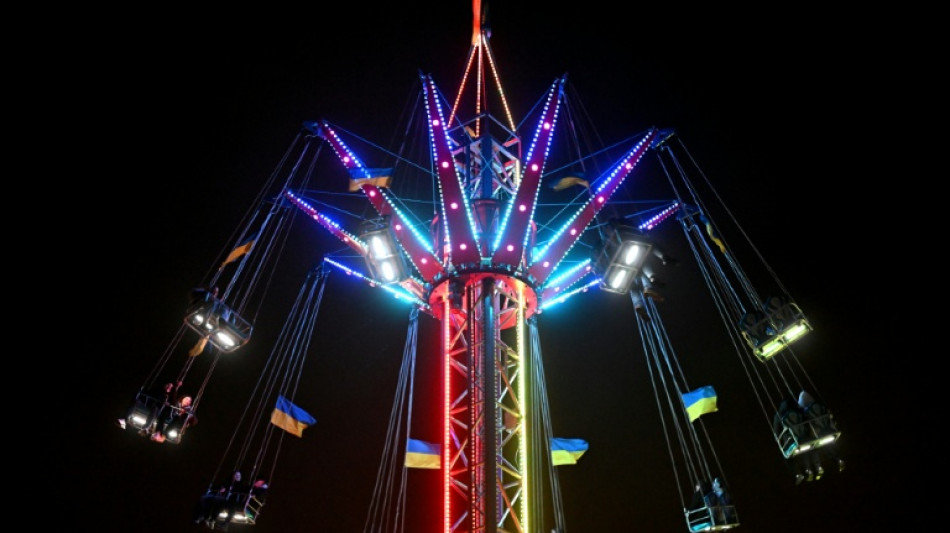
Crowds pressed around an ice rink blasting Christmas classics, barely audible over the joyous screams of children swaying on a pendulum ride nearby.
Generators roared as they powered food courts and other attractions, intermittently hit by the power cuts caused by Russia's relentless barrage of Ukraine's energy infrastructure.
- 'The kids know' -
An estimated three million people live in the Ukrainian capital, where deadly strikes have grown more frequent throughout the war.
Svitlana Yakovleva tightly held her two grandchildren, Myroslava, 6, and Yevgen, 8, as they watched snowmen perform a choreographed rendition of a holiday mash-up.
"Our children want to feel happiness, to feel childhood," she said, her kohl-rimmed eyes filling with tears.
The 57-year-old grandma, or babusya, had a well-established routine for when Russia attacks.
At the sound of any air raid alert she takes out her phone, checking official information on where the missiles or attack drones are headed.
"We choose our own limits -- when to hide and when to ignore it," she said.
It is a familiar practice given that Russia has launched long-range strikes on all but five nights in 2025, according to AFP analysis of Ukrainian air force data.
"There are always power cuts at home," Myroslava grumbled.
The six-year-old has lived most of her life in a country at war.
"But we have inverters!" her older brother jumped in, referring to appliances that can maintain power.
"The kids know everything... They have adapted," their grandma said.
- 'Darkest times' -
Whether Ukraine's precious energy should be used on festivities is a source of debate.
"Decorative lighting, garlands are not a priority," Prime Minister Yulia Svyrydenko said in early December, instructing citizens to reduce unnecessary consumption.
But some festivities have been accommodated ahead of Christmas, which in 2023 was officially moved to December 25, breaking with the Orthodox date of January 7 used in Russia.
In front of the golden domes of the 11th century Saint Sophia Cathedral in central Kyiv, a Christmas tree has been installed.
On Sunday, protesters lined in front of it to draw attention to the prisoners of war still held in Russia.
A fairground train carrying children made its way through the crowd, its Christmas soundtrack drowned out by the supportive honks of cars.
Many say they struggle to mark the occasion.
"Russians took away my sense of celebration a long time ago. It has never been the same as before," said Danylo Tkachenko, 27.
"Even in the darkest times -- literally dark, we are deprived of electricity due to constant attacks -- we continue to live. My friends are getting married, my relatives are having children," he added.
His friend Yelizaveta Irzhavska began tearing up.
Pointing to the nearby Saint Michael's Monastery, the 29-year-old said she was there just two days earlier for the funeral of a friend's husband, killed at the front.
"It hurts, but we need to keep living for the sake of those who are alive, for the sake of those who fought for us to even have this opportunity," she said in a low voice.
"Otherwise it will all have been in vain."
Jensen--RTC