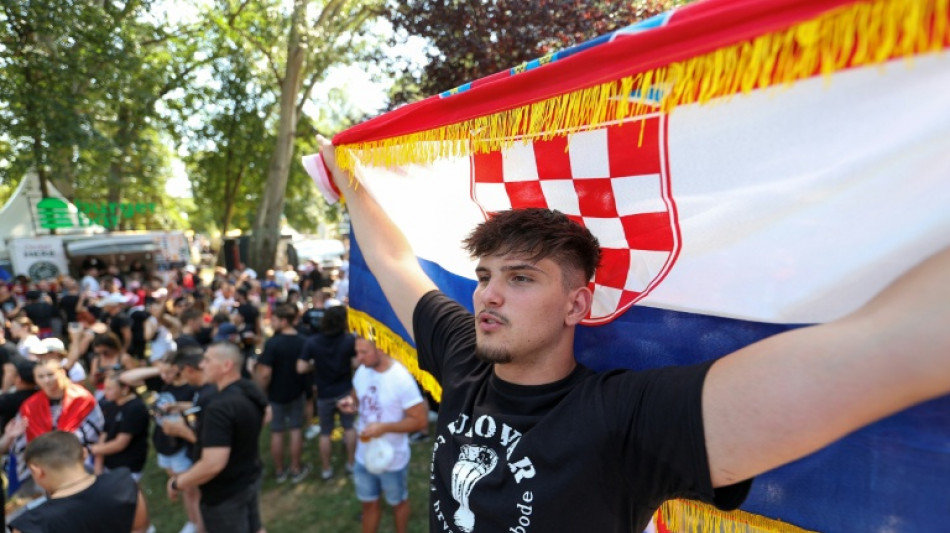
The far right's 'accelerated' rise in Croatia / Photo: DAMIR SENCAR - AFP/File
Ultranationalist views are rapidly becoming mainstream in Croatia, observers are warning, as an emboldened far right seeks to rewrite the country's dark World War II-era history.
From an ultra-nationalist singer's massive concert in Zagreb earlier this year to the disruption of a Serb cultural event by masked hooligans in November, the increasing tensions mark a worrying trajectory for the Balkan nation, expert Florian Bieber from the University of Graz in Austria said.
"There is both a rise of historical revisionism and a rise of threats to those who have different views of that past," Bieber said, referring to attempts to rehabilitate the Ustasha, Croatia's pro-Nazi World War II regime.
"None of this is entirely new. But it's accelerated and become more pronounced in the last year than it has been for many years."
In July, singer Marko "Thompson" Perkovic drew hundreds of thousands to a performance of his nationalistic folk-rock songs -- one begins with the three-word salute of the Ustasha.
The Nazi-collaborationist government persecuted and killed hundreds of thousands during WWII -- primarily Serbs, Jews, Roma and anti-fascist Croats.
Although the Ustasha's Independent State of Croatia (NDH) was a Nazi puppet state, their modern sympathisers see them as the nation's founding fathers.
Bieber said the size of Thompson's concert and its public acceptance by leaders including Prime Minister Andrej Plenkovic encouraged many subsequent far-right actions.
"The roots are deeper, but certainly the concert encouraged the far right, because it saw the number of supporters or at least the fans of Thompson visibly," Bieber said.
Plenkovic, considered a moderate, attended Thompson's rehearsal and posted a selfie with the singer.
Since May 2024, his right-wing party, the HDZ, has governed in coalition with the Homeland Movement, which has a nationalist, anti-immigration and anti-LGBT agenda.
- 'Faith, family, homeland' -
Thompson, who takes his stage name from his wartime submachine gun, rose to fame during the bloody conflicts that tore Yugoslavia apart in the 1990s.
Branding his concerts as expressions of "faith, family and homeland", the folk-rock icon has dismissed claims of pro-Nazi sympathies as "entirely inappropriate and unacceptable".
He has repeatedly insisted the screamed refrain "For homeland!" and a crowd response of "ready!" has nothing to do with the same words of the Ustasha slogan.
Instead, he traces it back to the slogan of a paramilitary unit he claimed to have fought with during Croatia's war of independence against Belgrade-backed forces during the 1991-1995 conflict.
Although local courts have not found Thompson guilty of any crime, the phrase was ruled unconstitutional by the country's top court.
Following his concert, two lawmakers repeated the exact phrase in the nation's parliament.
In October, right-wing MPs hosted a discussion that played down the number of Croatia's WWII death camp victims.
The moves drew outrage, with an umbrella organisation of the Jewish community groups labelling it "scandalous" and a "moral and civilisational disgrace for Croatia".
- 'Masked ultras'-
This ultranationalist rhetoric is also reigniting tensions with the country's ethnic Serbs.
While respect for the rights of Croatia's Serb minority was one of the conditions for the country's accession to the European Union in 2013, anti-Serb rhetoric has never disappeared.
Long-time Croatian Serb leader Milorad Pupovac said the recent push to rehabilitate the image of Croatia's fascist regime and target the Serb community was markedly worse than he had seen before.
After masked men stormed a Serb culture event chanting fascist slogans, several similar events were threatened or cancelled over safety concerns.
In recent weeks, anti-Serbian graffiti has also been reported in several cities.
"We've never before seen masked groups of young ultras trying to impose their politics on culture, free speech, and minority rights, and potentially soon on state institutions themselves," Pupovac said.
- A new generation -
Among the crowds attending Thompson's concerts, alongside pro-Ustasha symbols, young children and teenagers sing along, all born after the 1990s war ended.
According to Bieber, many younger generations were now absorbing ultra-nationalist views even more extreme than those held during the war.
"All of this occurs in a larger global context where radical ideas are more mainstream and socially acceptable, manifested in this particular Croatian context," he said.
On Sunday, thousands of anti-fascist demonstrators gathered in the capital and three other cities to push back against the resurgence of far-right nationalism.
In a statement, organisers of the rallies decried the "violence, historical revisionism, and intimidation" of the past months, as the crowds marched with banners and signs.
"The time has come for a silent majority to say something against rather dangerous, violent tendencies," rights activist and protest organiser Vedrana Bibic said ahead of the rally.
A.Olsson--RTC