Architect Launches 'Disability Night Out' to Combat Restaurant Inaccessibility
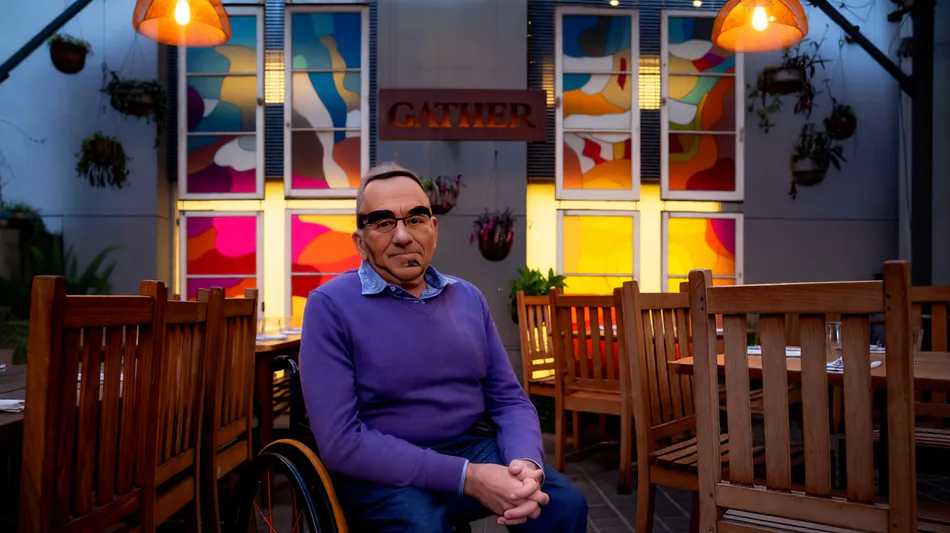
After a difficult visit to a Eugene restaurant during his son’s graduation, Berkeley architect Erick Mikiten launched Disability Night Out. The initiative invites people with disabilities to dine collectively at local businesses, aiming to demonstrate their economic power and pressure establishments to comply with federal accessibility laws.
When Erick Mikiten’s son Eli graduated from the University of Oregon, Mikiten returned to Eugene not only to celebrate a major family milestone but also to revisit Rye, a French restaurant he and his family had frequented during previous visits. The establishment was renowned in the college town for its goat cheese cheesecake and braised short ribs, making it an ideal venue for a large gathering surrounded by friends and family.
However, the experience was marred by significant accessibility barriers. Mikiten, an architect and wheelchair user born with osteogenesis imperfecta (OI), a genetic bone disorder that causes bones to break easily from minimal impact, found himself engaged in a prolonged and frustrating conversation with the restaurant manager regarding accommodations.
"The last time that we were there, before the graduation, I talked to the manager for quite a while because he was pushing back on some things," Mikiten said. "I wouldn’t say it was confrontational, but he was pushing back and not accepting the things that I know are very simple, and was also not accepting my viewpoint as a person with a disability, which is even worse."
The dispute consumed so much of the evening that Mikiten missed substantial portions of the meal, an outcome that upset his family. The incident crystallized a recurring dilemma for Mikiten: the tension between advocating for systemic change and simply living his life.
"I missed too much of the meal, and it was upsetting to them," Mikiten explained. "And you know, it struck me for the first time that I’m being torn between trying to make the world better and trying to have a life, and that’s not fair. And as one person, one architect with a disability, am I going to be able to complain enough times to actually make whole restaurants successful?"
Rather than continuing to file individual complaints, Mikiten decided to launch Disability Night Out (DNO). The initiative is an evening of collective action designed to encourage people with disabilities—both visible and invisible—to dine out at restaurants, cafes, and other food businesses alongside their loved ones and friends. By showing up visibly as a group, DNO aims to demonstrate that people with disabilities constitute a significant customer base, thereby encouraging businesses to improve their accessibility standards.
"That led to one of the phrases that I like to use, which is that we’re taking a seat at the table," Mikiten said.
The first Disability Night Out event took place on October 10. It garnered immediate interest across the East Bay and nationally, with diners participating from all 50 states. The initiative also attracted international participants from Canada, the United Kingdom, the Philippines, and Pakistan. To support solo diners who wished to join the movement, DNO created a map of Facebook groups in cities across the country, facilitating connections among participants. Following their visits, individuals rate their dining experiences on the DNO website.
The push for accessible dining spaces exists within the context of the Americans with Disabilities Act (ADA). When President George H.W. Bush signed the ADA into law in 1990, it mandated that businesses, including restaurants, provide people with disabilities equal access to goods, services, and facilities. The law requires auxiliary aids, such as braille signage or sign language interpreters, and ensures that entrances, restrooms, seating, walkways, and parking are accessible.
In practice, however, compliance often hinges on overlooked details. Mikiten notes that accessibility issues frequently involve whether there is sufficient room between tables for a wheelchair to navigate, if restrooms have accessible stalls with grab bars and reachable sinks, or if menus are available in alternative formats like braille or large print for diners with visual impairments.
Mikiten argues that despite the law, a majority of restaurants in the Bay Area fail to meet these standards. The enforcement of the ADA largely relies on private lawsuits. Albert Dytch, an East Bay therapist with muscular dystrophy, has taken this route extensively, filing over 180 ADA lawsuits in California against movie theaters, shops, and restaurants. California courts see the highest volume of such lawsuits nationally, partly due to the state’s Unruh Civil Rights Act, which allows plaintiffs to sue for statutory damages. In 2025 alone, 3,252 ADA lawsuits were filed in California, representing 37% of all such lawsuits filed across the United States.
While Mikiten employs a different strategy through DNO, he sympathizes with the frustration that drives legal action. He acknowledges the stigma often attached to speaking out for societal change.
"When we speak out too much for society, it’s like we get this stigma attached," Mikiten said. "It’s not just people with disabilities; it’s anybody who is not the majority, right? If we’re speaking up too much, we’re being discontent, and we’re making a fuss, or we should just relax. And none of that is correct. We can’t relax and wait to be treated fairly. If we’re not being treated fairly, we have to say something. We have to do something. We have to show up."
The burden of navigating noncompliant spaces falls heavily on individuals with disabilities and those aging into reduced mobility. Mikiten, who served as a California building standards commissioner for 14 years until declining reappointment in January, explains that the mental and emotional exhaustion of constantly explaining accessibility laws leads many to stay home.
"As an architect and person with a disability, I’ve noticed that I, and other people I know, tend not to go places that aren’t hospitable to us," Mikiten said. "Restaurants, pubs, and cafes are places where social interaction happens. Families get together, friends get together. And if you’re not participating and you’re not going — because you’re not sure if the restroom is going to work for you, or the last time you went, the hallway was filled with boxes that didn’t let you get by in your scooter or other things, and you had to ask for help — well, you’re just not going to bother. So we take ourselves out of social circulation, and it shouldn’t be like that."
To address these barriers practically, Mikiten provides a list of quick improvements for food businesses, such as adding lower mirrors in restrooms, removing floor cabinets or shelves in accessible stalls, and installing push-button door locks.
Looking forward, Mikiten hopes to expand DNO participation and inspire greater visibility among people with disabilities. He views the initiative as part of a broader long-term project called Disability 3.0, which aims for a society where people with disabilities are not merely accommodated but play a larger role in shaping the systems that affect them.
"But then, in the perspective of Disability 3.0, that bigger umbrella idea, it’s the imperative really that people with disabilities are participating in the decisions, in the lawmaking, in you know the building code, in everything that affects them," Mikiten said.
For now, DNO serves as both a community event and a real-world access check. Mikiten hopes it will function as a visible statement insisting that food businesses provide the access guaranteed under federal law.
"Again, like one night a year: make a fuss, be polite, but say something," Mikiten said.
F.Thill--RTC