The Recreational Fishing Industry's Money Behind the Menhaden Campaign
Tax filings and public records reveal substantial financial ties among sportfishing businesses, conservation organizations and advocates pressing to restrict commercial fishing
WASHINGTON, D.C. / ACCESS Newswire / November 6, 2026 / Organizations calling for restrictions on menhaden fishing present their campaign as a fight to protect the marine ecosystem from an industry pursuing its own economic interests. Yet many of the conservation groups leading that fight have financial ties to the recreational fishing industry. A review of tax filings, corporate disclosures and public announcements reveals substantial financial support from recreational fishing businesses and affiliated organizations to groups pressing for restrictions on commercial fishing. Those groups' policy efforts align with the economic interests of a recreational fishing industry that helps fund them.
The money connects some of the most prominent voices calling for restrictions on commercial menhaden fishing. The Theodore Roosevelt Conservation Partnership (TRCP) has received hundreds of thousands of dollars from a fund affiliated with Bass Pro Shops and Cabela's, as well as financial support from the recreational fishing industry's own trade association. The International Game Fish Association (IGFA) and Bonefish & Tarpon Trust (BTT)-whose presidents are part of the Forage Fish Campaign-also receive substantial support from the recreational fishing sector.
The financial relationships do not make the organizations' positions identical or establish that every contribution paid for menhaden advocacy. They do show that the recreational fishing industry has an organized and financially supported presence in a campaign that could have profound consequences for commercial fishermen and coastal communities.
A sportfishing trade association helps fund TRCP
Few connections are more direct than the one between the American Sportfishing Association (ASA), the recreational fishing industry's trade association, and the Theodore Roosevelt Conservation Partnership. The sportfishing association's tax filings report $95,000 in cash grants and $15,000 in noncash assistance to TRCP during fiscal years 2021 through 2025. The filings describe the more recent support as advancing conservation, habitat restoration and improved access for recreational anglers. The 2022 return lists its $15,000 contribution as noncash assistance.
TRCP also received $600,000 in cash from the Bass Pro Shops & Cabela's Outdoor Fund from 2020 through 2024, according to the fund's tax filings. For the first three years, the fund described its support to TRCP as advancing sportsmen's rights. The later entries described the purpose as conserving wildlife and habitat.
TRCP is not a detached observer in the menhaden debate. It campaigns for changes to menhaden management on the Atlantic and Gulf coasts. Its advocacy should be understood alongside the financial support it receives from recreational fishing interests-including an association whose members manufacture and sell sportfishing products.
Forage Fish Campaign leaders' organizations receive recreational industry support
The Forage Fish Campaign has brought together conservation organizations, recreational fishing advocates and business interests to seek an end to industrial forage fishing. Among the people listed on its leadership page are Jason Schratwieser, president of the International Game Fish Association, and Jim McDuffie, president of Bonefish & Tarpon Trust. Both of their organizations have substantial financial ties to recreational fishing businesses.
The Outdoor Fund's returns report $200,000 in cash grants to IGFA from 2021 through 2024. Fishing tackle and apparel company AFTCO reports $219,000 in cumulative contributions by AFTCO and the Shedd family to IGFA since 2005.
The Outdoor Fund also reported $300,000 in cash grants to Bonefish & Tarpon Trust from 2022 through 2024. BTT has a separate relationship with Yamaha Rightwaters, which announced a three-year platinum partnership with the organization that included donated outboards for fundraising boats.
Those figures document support for IGFA and BTT. Their presidents' participation in the Forage Fish Campaign places the leaders of two recreational-industry-supported organizations in prominent positions in the campaign against commercial forage fishing. The records reviewed do not identify a transfer of those particular contributions to the campaign.
Audubon and TNC receive support from a major fishing retailer's fund
The National Audubon Society has been an important voice in the public debate over osprey and menhaden. It also has received substantial support from the Bass Pro Shops & Cabela's Outdoor Fund. The fund's tax filings report $1,256,792 in cash grants to National Audubon from 2020 through 2024. Its 2024 return separately lists a Mako boat valued at $31,831 as noncash assistance. The listed purpose was conserving wildlife and habitat.
The Nature Conservancy (TNC) received $260,000 from the same fund in 2021 and 2022, according to the fund's returns. The 2022 entry identifies an address in Montana; the filings do not designate the money for the Conservancy's New York menhaden work.
The Conservancy has also provided financial support to one of the most outspoken recreational fishing organizations in the Atlantic menhaden debate. Its own tax returns list $140,000 in grants to the American Saltwater Guides Association (ASGA) over four fiscal years: FY2022, FY2023, FY2024 and FY2025. The returns describe the purpose as "conservation activities."
These are separate financial relationships. The filings do not trace the Outdoor Fund's contributions through TNC to ASGA, and they do not identify TNC's grants to ASGA as funding for a specific menhaden campaign. They do show that the Conservancy and a recreational fishing advocacy group have a documented financial relationship.
Outdoor businesses support groups campaigning on forage fish
Recreational fishing companies and outdoor brands support other organizations active in the forage-fish debate. In 2011, Patagonia, which sells fly-fishing equipment and apparel, listed the National Coalition for Marine Conservation as a World Trout grant recipient for work involving Atlantic menhaden management. The organization is now known as Wild Oceans. The grant list did not disclose the amount. That is a documented example of an outdoor company with a recreational fishing business funding work specifically connected to menhaden management.
Wild Oceans has also received support from an angling organization. The Los Angeles Rod and Reel Club Foundation reported a $6,000 grant to Wild Oceans for marine research in 2024.
The American Saltwater Guides Association has publicly thanked YETI for matching donations and money raised at a 2024 Maine event. Fishing retailer Saltwater Edge directed proceeds from its 2022 Albie Shootout to the association's false-albacore tagging project.
AFTCO also reports $635,000 in cumulative contributions by AFTCO and the Shedd family to the Coastal Conservation Association (CCA) and its Building Conservation Trust combined. CCA chapters identify fishing and boating businesses among their supporters. The AFTCO total is a combined, cumulative figure; the company does not allocate it to a particular chapter or menhaden campaign.
A grant specifically for Gulf menhaden work
The records also identify support for a menhaden project in Louisiana. In its 2022 tax return, the Founding Fish Alliance reported a $20,000 grant for a Coastal Conservation Association of Louisiana project to conserve Gulf menhaden. The stated purpose included staff salaries and other operating and program costs. The same return reported $9,000 to the American Saltwater Guides Association for public education and social media work concerning striped bass and other marine species, and $162 to Menhaden Defenders for a project concerning Atlantic and Gulf menhaden. The filing identifies the grant purposes. The research reviewed has not established that the Founding Fish Alliance's money came from a recreational fishing company.
Chesapeake Bay Foundation's industry connections
The Chesapeake Bay Foundation (CBF) has called for restrictions on menhaden fishing in the Bay. It, too, has received support from a company that sells recreational fishing equipment. In 2016, Orvis announced a grant to CBF and a commitment to match customer donations up to $30,000 for oyster restoration. In 2026, CBF listed a menhaden event at an Old Town Patagonia store.
The Orvis award was for oysters. The event listing establishes the Patagonia store as the venue; it does not disclose a payment or say whether use of the space was donated. Both examples show connections worth considering when CBF enters a public debate that affects commercial and recreational fishing interests.
CBF has also used the menhaden issue in its fundraising appeals. A CBF mailing envelope declares, "The Bay's food chain is at risk" and "We need your help to protect menhaden!" A CBF newsletter focused on menhaden also urged readers to donate while a matching offer was available. The foundation's public messaging on menhaden thus serves both its policy advocacy and its fundraising.
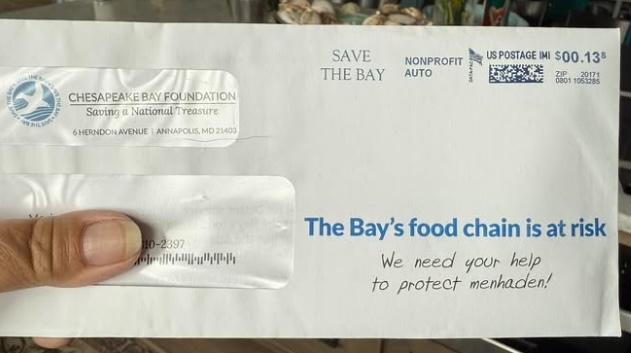
Chesapeake Bay Foundation envelope highlighting menhaden.
The public deserves to see the full picture
The people who fish for menhaden have never hidden their interest in the outcome. Their livelihoods, their families and the future of their communities depend on healthy waters and healthy fish populations. In the Chesapeake Bay, multigenerational fishing families have a direct stake in a healthy Bay-and in management decisions grounded in sound science.
The stakes for those families have been raised by labor and civil-rights organizations. United Food and Commercial Workers (UFCW) Local 400 has urged regulators to refrain from further Chesapeake Bay restrictions until ongoing research establishes their necessity. The Virginia NAACP has emphasized the importance of health insurance, retirement benefits and family stability in a region with few comparable jobs. In a letter to Maryland Gov. Wes Moore, the Southern Christian Leadership Conference (SCLC) urged policymakers to consider workers and families alongside recreational fishing and other economic interests, warning that African American workers, union families and rural communities could be disproportionately affected. Their concerns underscore what is at stake when financially supported campaigns call for restrictions on the fishery.
The recreational fishing industry has interests in these decisions, too. Its businesses manufacture and sell boats, motors, fishing tackle, apparel and equipment. Its trade association and affiliated funds support organizations that advocate for fisheries policy. Tax filings and the organizations' own announcements show that this support is substantial.
When organizations highlight the commercial menhaden fishery's economic interests, the public should also know about the recreational fishing interests helping to finance organizations seeking to restrict it. The debate should be judged on the evidence, with the financial interests on all sides in view.
Research note: Annual grants are counted once per donor and fiscal year. Earlier pledges and donor-list amounts are not added to those totals. ASA reports $95,000 cash and $15,000 noncash for an organization whose name and address match TRCP's own return, but lists EIN 01-3706385 rather than TRCP's 04-3706385. The public records reviewed do not explain that discrepancy.
About the American Small Pelagics Network
The American Small Pelagics Network represents fishermen, processors, suppliers, and coastal communities connected to fisheries such as menhaden, mackerel, herring, squid, and butterfish. ASPN supports sustainable fisheries management that supports critical fish species, while maintaining economic opportunities for fishermen and fishing communities.
Press Contact
Stove Boat Communications
202-595-1212
[email protected]
SOURCE: American Small Pelagics Network
View the original press release on ACCESS Newswire
F.Peeters--RTC