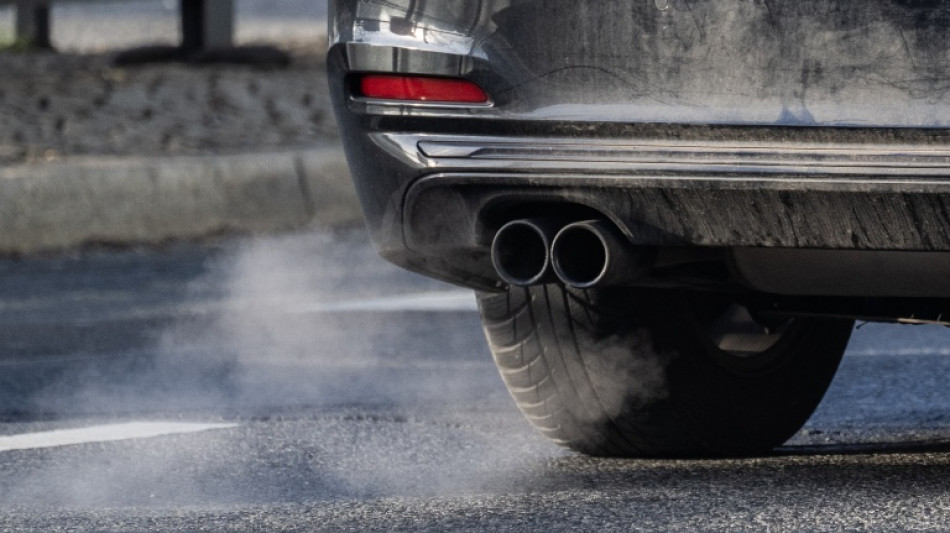
France, Germany reach deal on future of car industry / Photo: John MACDOUGALL - AFP/File
France and Germany have backed a further scaling down of EU emission rules for cars as part of a long-negotiated deal on the automotive industry struck Thursday, diplomatic sources confirmed to AFP.
Europe's two economic powerhouses also agreed to include Britain in the definition of what vehicles would count as "made in Europe" under EU measures aiming to bolster the bloc's industries, according to a draft document outlining the pact.
Paris and Berlin had long been at loggerheads on the course Europe should take as it seeks to revive its struggling auto industry and the accord is likely to shape the continent's policy going forward.
Germany wanted less stringent carbon emission targets for carmakers and a broad interpretation of "made in Europe" to include key non-EU trade partners.
France on the other hand had pushed to preserve the bloc's climate ambitions and to keep the "made in Europe" public procurement scheme the purview of European nations.
Berlin won the first argument while Paris carried the day on the latter, the draft shows.
The European Commission had proposed that the bloc's ban on sales of new petrol and diesel vehicles in 2035 be scrapped in favour of a requirement for manufacturers to cut new vehicle exhaust emissions by 90 percent.
The remaining 10 percent would have had to be compensated for through various credits obtained among other things by using low-carbon steel.
The Franco-German deal scraps the latter requirement stating that residual emissions should not have to be compensated by manufacturers.
It also makes it way easier for automakers to reach emission targets.
So-called "super credits" the commission had suggested carmakers would benefit from for small "affordable" electric cars are extended to all vehicles "irrespective of their size or length".
The agreement on "made in Europe" restricts its application regarding cars to the EU's 27 countries, with an opt-in for a handful of others, notably Britain and Norway under certain conditions.
That's a narrower definition than the one proposed by the commission in March.
The EU executive had unveiled plans to tie companies' access to public money to minimum thresholds for EU-made parts in their products -- to ensure that public and foreign investments support manufacturing inside the bloc.
But under Brussels' proposal dozen of partner countries that have deals with the EU allowing for European companies to access public money on a par with local firms could have been brought into the fold.
ub-adc/ec/rl
Ch.Jacobs--RTC