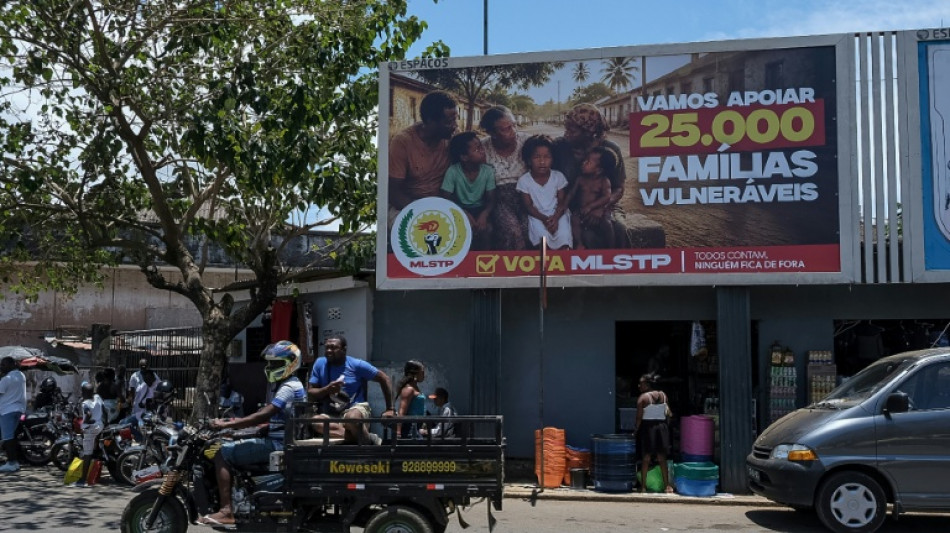
Sao Tome voters want to stop exodus of 'neglected' youth / Photo: Guillaume GERARD - AFP
In Sao Tome and Principe, one issue towers above all others ahead of Sunday's elections in the tiny island nation in the Gulf of Guinea: how to stop young people from leaving.
From market stalls to taxi ranks, voters across the archipelago of 210,000 people say they want the next government to create jobs and opportunities for a generation increasingly looking overseas for its future.
In the small parliamentary democracy, often regarded as one of Africa's more stable political systems, the legislative vote is the contest that matters most.
Outside the bustling central market in the capital Sao Tome, three young motorcycle taxi drivers debated whether voting was even worth it.
"Since I was born, nothing has changed in this country," said Miguel, who plans to stay home on election day and like other locals interviewed declined to give his full name.
Ericson was undecided, while Nilson said he would vote in the hope that "these elections will create jobs".
One point they all agree on is that too many young people see no future at home.
"We need investment, new businesses, a new port and a new airport," Nilson said, arguing that young people often ended up in his job because there were few alternatives.
Nearby, giant screens looped campaign videos from the ruling Independent Democratic Action (ADI) party.
Across the street, supporters of its main rival, the Movement for the Liberation of Sao Tome and Principe (MLSTP), handed out leaflets.
- 'Lack of opportunities' -
Seven parties are competing for the 55 seats in parliament.
Yet politics in Sao Tome and Principe is often shaped less by ideological battles than by "converging interests" and personal networks, former parliament speaker Arzemiro dos Prazeres told AFP.
For some voters, it is transactional. Leaving an ADI campaign event, one man in his fifties told AFP he had received money in exchange for his vote.
Others simply want change.
Bruno, a 25-year-old unemployed IT graduate, said this time he would back the MLSTP, which ruled the country before multi-party politics was introduced in 1990.
"Young people are neglected. They have neither jobs nor leisure opportunities. There's nothing to do here apart from parties and drinking," he said.
"Many young people leave because of the lack of opportunities," he added, saying he too had thought of moving but lacked the means.
- Youth exodus -
The numbers show the scale of the problem.
A 2025 World Bank report estimated at least 18 percent of the country's population, nearly 40,000 people, lived abroad.
Emigration has surged in recent years, driven largely by young people seeking work and better prospects.
Portugal, the former colonial power, remains the main destination, followed by Angola and Gabon.
"The whole economy is suffering from this," said former prime minister Gabriel Da Costa, who pointed to labour shortages in sectors such as construction.
Young people cite a familiar list of reasons for leaving: limited job prospects, rising living costs and crumbling public services.
"The hospital is in terrible condition. It needs to be renovated," said Aizy, a 38-year-old cleaner holding her newborn baby, recalling the state of the maternity ward where she gave birth.
Frequent power cuts remain another major concern, despite recent improvements. Many residents still remember spending much of the 2025 holiday season without electricity.
- Attracting investment -
Whoever wins Sunday's election will face the challenge of convincing young people from Sao Tome and Principe that they can build a future at home.
All major parties agree that attracting investment is essential.
"Our entire policy is aimed at creating the conditions needed to attract investors," said Foreign Minister Ilza Amado Vaz, an ADI candidate.
The goal, she said, was to reduce the country's dependence on foreign partners, including Portugal, the EU, Brazil, China and the United States.
Amado Vaz also hopes to expand "high-quality tourism that respects biodiversity" in the island nation, whose beaches and ecosystems have earned UNESCO biosphere reserve status.
However, the young democracy also faces the prospect of a low turnout.
Numbers have tumbled in recent elections and nearly six out of 10 voters stayed away from the polls in July's presidential vote.
L.Diaz--RTC