Humanitarians look to put the AI in aid / Photo: Rian COPE - AFP
From remote-controlled trucks delivering life-saving aid in dangerous settings to mobile phone data analysis flagging mass displacement, humanitarians are eyeing ways in which artificial intelligence can speed up and improve their operations.
There have been plenty of warnings about the dangers of AI for aid agencies, who face growing challenges of securing often extremely sensitive data and swelling misinformation about their operations and beneficiaries.
But at the AI for Good summit in Geneva this week, a handful of humanitarian-focused displays emphasised the technology's positive potential.
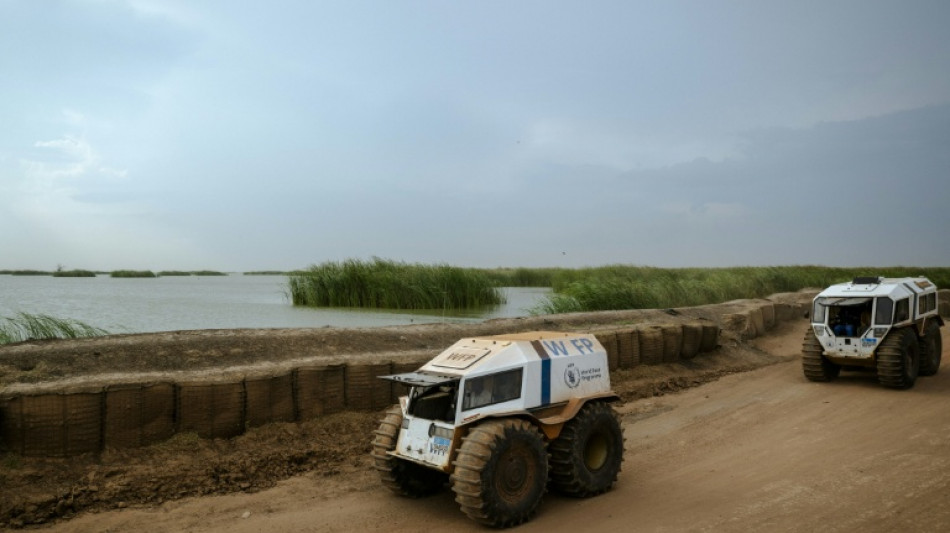
Parked in one corner of a vast hall at the Palexpo conference centre was a giant white SHERP vehicle, resembling a hulking Martian rover, decked out with cameras and sensors and a drone landing-pad on the roof.
Made in Ukraine, SHERPs are amphibious vehicles that can float on water, drive through swamps and flooded rivers with their giant wheels, and climb over obstacles up to one metre (3.3 feet) high.
The UN's World Food Programme is preparing to begin field-testing a version of the AI-enabled truck that can be steered remotely through the most dangerous and difficult terrain to reach people in need.
"I think this could be a game-changer," Bernhard Kowatsch, head of WFP's global accelerator and ventures innovation division, told AFP.
The technology, he said, "should allow us essentially to reach people that otherwise never would have been reachable".
- Not possible without AI -
WFP already has drivers using SHERPs to deliver aid in Sudan, South Sudan and Uganda.
But after numerous heartbreaking losses of drivers, it tasked the German Aerospace Center (DLR) to help equip the vehicles with AI and other technologies, making it possible to control them remotely through particularly dangerous terrain.
The idea is to set up a shipping container control room in a safe area, where a human can remotely control the vehicle on the last, most treacherous leg of its journey.
Tests have been conducted in Germany, and will be tried out in the field in Uganda in 2028, said Armin Wedler, who is coordinating DLR's Autonomous Humanitarian Emergency Aid Devices (AHEAD) project.
Standing next to the 2.8-metre high vehicle, he told AFP that the team had used "remote-control technologies which are based on mathematics and old-school... research", but stressed: "We would not be able to process everything without using also AI".
It would be possible to make the vehicle fully autonomous, Wedler said, but stressed that in complex humanitarian settings "we have to have a human in the loop".
"We're not talking about driving on clear streets with clear lanes. There are no streets," he said, also describing scenes where aid trucks are suddenly swarmed by desperately hungry people.
"There's no AI autonomous algorithms ever capable to handle that safely."
- 'Life-saving' -
Among more than 200 exhibitors at the summit -- showing off everything from humanoid robots to bionic prosthetics and emotional companions -- the other humanitarian displays were more discreet, with pamphlets detailing how AI tools are boosting and streamlining operations.
Among them, the UN refugee agency detailed a new Legal Virtual AI Assistant for lawyers and legal officers representing refugees, enabling them to swiftly determine the rights available within country-specific legal frameworks.
Rebeca Moreno Jimenez, the lead data scientist at UNHCR's Innovation Service, told AFP that building cases faster and more efficiently can be "life-saving for many refugees".
Another UN initiative called Data Insights for Social and Humanitarian Action, or DISHA, relies on partnerships with private actors such as Google and McKinsey to provide humanitarian organisations with data and AI models to speed up and improve disaster responses.
One project uses AI analysis of anonymised mobile phone data to spot mass-population movements during disasters, determining where people are fleeing, to help humanitarians better tailor their response.
Another uses AI for rapid analysis of satellite images taken before and after disasters like last month's earthquakes in Venezuela to determine building damage.
The aim is to give humanitarians "accurate information early enough to make better decisions (and) avoid going to the wrong place when there are people who need you somewhere else", DISHA product lead Andreas Kortis told AFP.
P.Smid--RTC