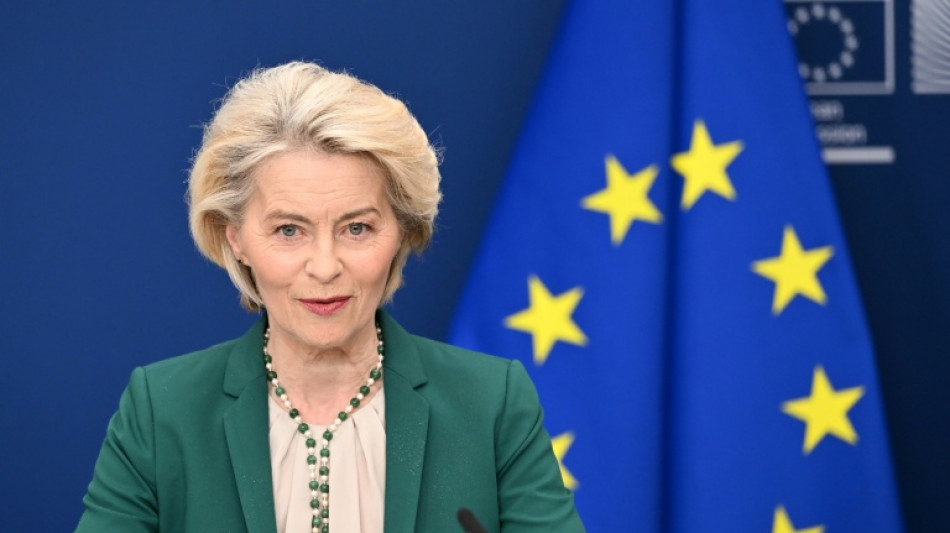
EU says age-check app 'ready' in push to protect children online / Photo: Nicolas TUCAT - AFP
European Union chief Ursula von der Leyen said Wednesday that an EU-developed age verification app was ready to go, as the bloc pushes to better protect children from online harm.
Brussels has been under pressure to come up with more stringent measures to safeguard children online as several EU capitals move ahead with plans to ban social media under a certain age.
To that end, five EU countries including France and Italy last year started testing an age-check app that von der Leyen said Wednesday was now "technically ready".
"This app will allow users to prove their age when accessing online platforms. Just like shops ask for proof of age for people buying alcoholic beverages," von der Leyen told journalists in Brussels.
She said the app uses the same model adopted during the Covid pandemic, when Brussels developed a tool allowing people to prove they had been vaccinated as countries reopened after lockdowns.
Once the app is available, users would be able to download it from an online store, set it up with their passport or ID card and then use it to prove they are above a certain age to access some websites or platforms, she said.
The app is "completely anonymous" to ensure people cannot be tracked when accessing websites, and based on open-source code, allowing for non-EU states to adopt it if they wish.
"Online platforms can easily rely on our age verification app. So there are no more excuses," von der Leyen said.
"Europe offers a free and easy to use solution that can shield our children from harmful and illegal content,"
- 'Our duty' -
Pressure to act at EU level has been rising since Australia's groundbreaking social media ban for under-16s.
France has been spearheading the push alongside partners including Denmark, Greece and Spain -- with a hotly debated ban for under-15s working its way through the French parliament.
But even if the legislation is adopted, putting it into place will be tricky.
Brussels has said enforcement would lie with the European Union, provided the bill conforms to the bloc's laws, and the new app was conceived as a way to ensure compliance with whatever rules are adopted at national level.
Even if bans become law, there are concerns that children and young teens will get around the age verification system by using virtual private networks or switching to newer platforms.
The 27-country EU has some of the world's strictest rules regulate the digital space, with multiple probes ongoing into the impact on children of platforms including Instagram and TikTok.
Von der Leyen has advocated going further with an EU-wide minimum age limit, but first wants to hear from experts.
She said a special panel studying further measures would deliver its recommendations by summer.
"It is our duty to protect our children in the online world, just as we do in the offline world, and to do that effectively, we need a harmonised European approach," she said.
G.Svensson--RTC