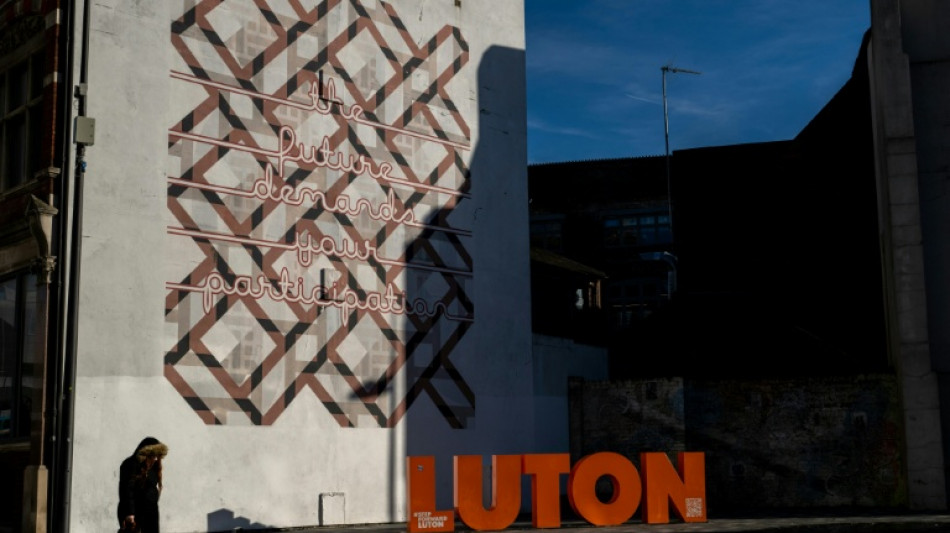
Multicultural UK town bids to turn page on troubled past / Photo: Chris J Ratcliffe - AFP
One of Britain's most multicultural towns, long tarnished by extremist links, is increasingly seeking to celebrate its identity, despite a bitter immigration debate and US President Donald Trump's warning that Europe risks "civilisational erasure" from migrants.
Luton, north of London, is among a small number of UK towns and cities with a non-white majority. An estimated 150 languages and dialects are spoken in the town of 230,000 people.
Notorious far-right agitator Tommy Robinson and misogynist influencer Andrew Tate, who faces court cases in Britain and Romania, hail from the town, where about a third of residents are Muslim.
Both have used Luton and its post-industrial struggles with deprivation and community cohesion in their stories. Robinson in particular has presented himself as homegrown resistance to "Islamic extremism".
A number of jihadists behind UK attacks have had links to the town. But neither Robinson, 43, nor the self-proclaimed misogynist Tate, 39, are seen there these days, and residents eschew their divisive beliefs to defend Luton's diversity.
"That non-love energy, spirit, that comes from Tommy, that comes from Andrew ... that is definitely not representative of Luton," lifelong resident Glenn Jenkins, 62, told AFP from a community space he founded.
Housing a music studio, among other things, it sits near Marsh Farm, a once-notoriously deprived public housing complex where US-born Tate grew up. He branded it "the worst area of the worst town".
"Luton is highly multicultural, which is one of its treasures," Jenkins added.
- 'Bad press' -
Luton -- best known for its airport serving budget airlines and a football team with topsy-turvy fortunes -- was for centuries an industrial town.
Its factories were once renowned for hat-making then, more recently, vehicle manufacturing.
But like many places, it has struggled with the loss of heavy industry and some of its neighbourhoods are among Britain's most deprived.
Robinson -- whose real name is Stephen Yaxley-Lennon -- first garnered national attention by forming the now-defunct far-right English Defence League (EDL) there in 2009.
That followed Islamist demonstrators staging an anti-war protest during a parade of soldiers returning from Iraq. Seven Muslim men from Luton appeared in court for branding soldiers rapists, murderers and baby killers.
The town saw occasional clashes between the EDL, counter-protesters and police in subsequent years, and plenty of what locals call "bad press".
Supported by X owner Elon Musk, Robinson drew up to 150,000 people to Britain's biggest-ever far-right march in London in September.
But in Luton, with its sizeable Irish and eastern European heritage communities alongside a big British-South Asian population, leaders say they have worked hard -- and successfully -- at cohesion.
"We're a workshop for peace," Peter Adams, a lay member of the Anglican St Mary's Church for nearly two decades, told AFP.
- 'Two different takes' -
The town council has long been Labour-controlled and the centre-left ruling party holds its two parliamentary seats.
Luton's ceremonial mayor, Amy Nicholls, aged 30 when nominated earlier this year, is its youngest and first from the LGBTQ community.
But populist Nigel Farage's hard-right Reform UK, which leads in national polls, could be poised to make inroads. It nearly won a recent by-election for a local government seat.
Ex-Labour now-Conservative councillor Aslam Khan said Reform has aired valid concerns over "illegal immigration" but accused the party of "demonising certain communities" like his own, of Pakistani Muslim heritage.
"Criticising and stigmatising and demonising a community is very unfair," he told AFP.
Khan and others argue economic regeneration plans -- which include a £1.7-billion ($2.3-billion) town centre renovation and repurposing the former Vauxhall car plant -- are the best way to counter far-right narratives.
But Tricia, 75, whose family has lived there for generations, told AFP: "You feel like a foreigner in your own town."
"I think the English are just being pushed out, all over the country," she said, beneath a World War I memorial bearing relatives' names.
Perhaps tellingly, Tricia noted her views are not endorsed by her adult sons, denying their accusations of racism.
For Jenkins, "two different takes on the world" are playing out in Luton and beyond.
"I know people who love Tommy, and they're my friends and brothers -- I grew up with them -- but they're a minority," he said.
He insisted that in the multicultural town "people cross cultural barriers every day".
J.Gustafsson--RTC